
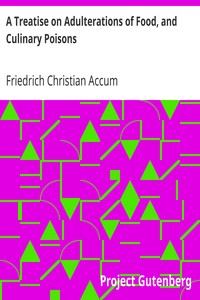
A Treatise on Adulterations of Food, and Culinary Poisons by Accum
Published in 1820, this book doesn't have a plot in the traditional sense. Instead, its 'story' is a systematic, shocking investigation. Friedrich Accum, a respected chemist, took it upon himself to analyze the food and drink commonly sold in London. He went shop to shop, buying samples and testing them in his lab. What he uncovered was a widespread, dangerous practice of adulteration—the deliberate contamination of food to increase weight, improve appearance, or cut costs.
The Story
Accum methodically works his way through the pantry of Regency England. Each chapter feels like a new revelation. He shows how bakers added alum to make bread dazzlingly white, how brewers used poisonous substances like cocculus indicus to make weak beer seem more intoxicating, and how confectioners used copper and lead salts to give candies bright greens and yellows. He even details how 'fine' green tea was often just black tea painted with toxic verdigris. The most gripping part isn't just the science; it's that Accum published the names and addresses of the merchants he caught. He turned a scientific report into a public blacklist, creating immediate uproar and backlash from the powerful food lobbies of the day.
Why You Should Read It
You should read this because it connects directly to our world. Every time you read a label, hear about a food recall, or trust a safety standard, you're seeing the long-term result of fights started by people like Accum. His voice is direct, furious, and surprisingly modern. You can feel his outrage on every page. It transforms dry history into a personal mission. Reading it makes you look at your own groceries differently and gives you a deep appreciation for the regulations we often take for granted. It's also a story of courage; Accum's work ruined his career and forced him to flee England, but his book changed everything.
Final Verdict
This is a must-read for anyone interested in the history of food, science, or consumer rights. It's perfect for fans of true crime or investigative journalism, but where the crime scene is the dinner table. If you enjoy shows or books that expose hidden systems, you'll be glued to this. Fair warning: it might put you off your tea for a week. A fascinating, foundational, and frankly alarming piece of history that reads like a thriller.
This work has been identified as being free of known copyright restrictions. It is now common property for all to enjoy.
Margaret Hernandez
4 months agoThis is now a staple reference in my professional collection.
Emily White
1 year agoHaving read the author's previous works, the author’s unique perspective adds a fresh layer to the discussion. An excellent example of how quality digital books should be formatted.
Paul Johnson
2 months agoI wanted to compare this perspective with traditional views, the author clearly has a deep mastery of the subject matter. I'm genuinely impressed by the quality of this digital edition.
Ashley Johnson
6 months agoI've gone through the entire material twice now, and the chapter on advanced strategies offers insights I haven't seen elsewhere. I am looking forward to the author's next publication.

Christopher Rodriguez
3 months agoIt’s refreshing to see such a high standard of digital publishing.