
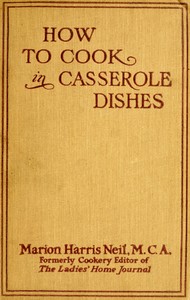
How to Cook in Casserole Dishes by Marion Harris Neil
I picked up this slim, worn volume expecting a simple collection of old recipes. What I found was a fascinating snapshot of early 20th-century home economics and a passionate argument for kitchen simplicity.
The Story
There's no fictional plot here, but there is a clear narrative. Marion Harris Neil wrote this book in 1919, right after World War I. Resources were tight, and many households had fewer servants. Her 'story' is about empowering the everyday cook. The book systematically introduces the casserole dish—not just as a piece of crockery, but as the hero of the kitchen. She walks you through the basics, from choosing the right dish to mastering slow, even cooking. The recipes are the chapters: soups, meats, seafood, vegetables, and even desserts, all reimagined for the casserole. You see her adapting fancier, more labor-intensive dishes into manageable one-pot wonders. It's a complete guide to a whole cooking philosophy.
Why You Should Read It
This book is a joy for two big reasons. First, it's a direct line to your great-grandmother's kitchen. The ingredients and some methods (like cooking a whole dinner in a 'fireless cooker') are historical curiosities. But second, and more importantly, Neil's voice is wonderfully practical and encouraging. She's not a stern chef; she's a helpful guide who genuinely wants to make your life easier. Reading her tips, you realize the struggle for quick, nutritious family meals isn't a modern invention. Her core principles—plan ahead, use what you have, minimize cleanup—are as relevant today as ever. It made me appreciate the humble casserole as a tool of culinary freedom.
Final Verdict
This isn't your go-to for tonight's dinner (unless you have a jar of condensed soup and a can of tuna from 1919). But it's perfect for food history lovers, curious home cooks, and anyone who finds charm in old manuals. If you enjoy seeing how daily life has evolved, or if you just love the idea of 'grandma hacks' from a century ago, you'll get a kick out of this. It's a gentle, insightful reminder that good cooking is often about working smarter, not harder.
Legal analysis indicates this work is in the public domain. Use this text in your own projects freely.
Michael Wilson
11 months agoA sophisticated analysis that fills a gap in the literature.
Emily Jackson
4 months agoBefore I started my latest project, I read this and the way it challenges the status quo is both daring and well-supported. Well worth the time invested in reading it.
Paul Williams
1 year agoBefore I started my latest project, I read this and the way it challenges the status quo is both daring and well-supported. It’s a comprehensive resource that doesn't feel bloated.
Richard Smith
1 month agoLooking at the bibliography alone, the cross-referencing of different chapters makes it a great study tool. I’ll definitely be revisiting some of these chapters again soon.






Richard Johnson
9 months agoThe research depth is palpable from the very first chapter.