
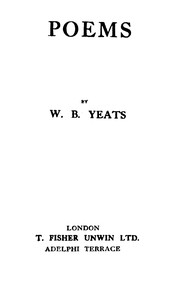
Poems by W. B. Yeats
Okay, let's be clear: this isn't a book with a plot in the usual sense. There's no detective to follow or kingdom to save. Instead, Poems by W. B. Yeats is the story of a man's inner life, told across decades. It's arranged more or less in the order he wrote them, which is the magic trick. You don't just read poems; you watch a person grow up, get his heart broken, get angry, and grow old.
The Story
We begin in the misty, dreamy world of Celtic folklore. The young Yeats gives us "The Stolen Child," inviting us (and maybe himself) to escape to a magical realm. Then, for a long stretch, we're in the thick of his painful, decades-long love for Maud Gonne. Poems like "He Wishes for the Cloths of Heaven" show a man so in love he'd lay the sky at her feet. But the tone shifts. The dreamer gets frustrated. The Easter Rising of 1916 happens, and his poem about it is fierce, confused, and awe-struck, asking "A terrible beauty is born." In his later years, the poems become tougher, grittier. In "Sailing to Byzantium," an aging man rejects the noisy world of the young for the timeless world of art. The journey ends with stark, powerful poems like "The Circus Animals' Desertion," where he admits that all his fancy symbols started in the "foul rag and bone shop of the heart." The story is the slow, sometimes painful, transformation of a dreamer into a clear-eyed realist.
Why You Should Read It
I love this book because Yeats doesn't let you stay comfortable. Just when you settle into his lovely rhythms about swans and towers, he throws a line that cuts right to the bone. He's brutally honest about longing and failure. His love poems aren't just sweet; they're full of obsession and regret. His political poems aren't simple cheers; they're complicated and sad. He makes the personal feel epic and the epic feel deeply personal. Reading him is like having a conversation with the smartest, most passionate person in the room—one who isn't afraid to tell you he's been wrong, or that he's scared of getting old. It's emotionally generous writing.
Final Verdict
This collection is perfect for anyone who thinks poetry is too vague or flowery. Yeats is direct and powerful. It's for the romantic who has been let down by the world, the history nerd who wants to feel Ireland's turbulent past, and anyone staring down their own life changes and looking for a voice that understands. It's not a quick read; it's a companion. Dip in, sit with a poem, and see which version of Yeats speaks to you today.
This publication is available for unrestricted use. Feel free to use it for personal or commercial purposes.
Jennifer Wilson
6 months agoGreat value and very well written.
Mary Taylor
3 months agoLooking at the bibliography alone, the level of detail in the second half of the book is truly impressive. Definitely a five-star contribution to the field.

Karen White
6 months agoThe citations provided are a goldmine for further academic study.