
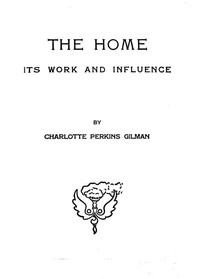
The home: its work and influence by Charlotte Perkins Gilman
Okay, let's break this down. 'The Home: Its Work and Influence' isn't a novel. Forget about a plot with a beginning, middle, and end. Think of it as a long, passionate essay or a series of connected lectures. Gilman takes the concept of 'home'—the physical house and the family life inside it—and puts it under a microscope.
The Story
There's no traditional story here. Instead, Gilman builds a case. She starts by looking at the home as an economic unit, arguing it's a primitive, inefficient factory where one person (the wife) does too many different jobs poorly. She then examines how this isolation affects women's minds and health, how it limits men by making them sole providers, and how it mis-educates children by keeping them in a small, overly personal world. Each chapter tackles a different room or function—the kitchen, the nursery, the idea of 'mother love'—and shows how the home's design and customs create problems. Her 'solution' is radical for 1903: professionalize domestic work (have experts cook and clean for multiple families) and redesign living spaces as communal, efficient apartments, freeing women to participate in the wider world.
Why You Should Read It
I picked this up out of historical curiosity and ended up underlining something on nearly every page. What's incredible is how current it feels. We're still arguing about the mental load, about who does the dishes, about the isolation of stay-at-home parents, and about whether our living spaces serve us well. Gilman connects the dots in a way I'd never considered. She made me see my own apartment not just as a place, but as a system with a history and a set of assumptions baked into the walls. Her writing is sharp, sometimes funny, and often impatient. You can feel her frustration with the obvious (to her) flaws that everyone else just lived with. It's a foundational text for understanding modern feminism and the history of how we live.
Final Verdict
Perfect for anyone interested in the history of everyday life, feminism, or social design. If you've ever felt overwhelmed by housework, wondered why suburbs feel isolating, or questioned traditional family roles, Gilman was asking the same questions 120 years ago. It’s not a light read—it’s a challenging, thought-provoking one. You won't agree with every point (some ideas are very much of their time), but you will come away looking at your own front door with completely new eyes.
You are viewing a work that belongs to the global public domain. Access is open to everyone around the world.
Kevin Miller
1 year agoHonestly, the flow of the text seems very fluid. Absolutely essential reading.
Liam Thompson
1 year agoSurprisingly enough, the flow of the text seems very fluid. I couldn't put it down.
Lisa Thompson
9 months agoI have to admit, the storytelling feels authentic and emotionally grounded. Absolutely essential reading.
Kevin Perez
1 year agoHonestly, it provides a comprehensive overview perfect for everyone. A true masterpiece.






Matthew Wilson
1 year agoTo be perfectly clear, the arguments are well-supported by credible references. A valuable addition to my collection.