About 607 minutes
Housekeeping in Old Virginia — Edition Insights
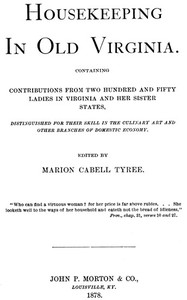
Housekeeping
139,537 recorded words. 307 minutes difference from this book's estimate.
View Gutenberg source #42450
The catalog record for Early English Meals and Manners — A Reader’s Guide provides practical reading context through 210,005 words, 15 hr 14 min estimated reading time, and 52 detected text sections.
The text analysis averages about 15.0 words per sentence, while the detected sections provide another way to judge how the source is divided.
Project Gutenberg metadata also associates the work with “Etiquette,” connecting these edition facts with the source record’s subject description.
Explore this collection
These alternatives are selected using recorded categories and estimated reading time.
About 607 minutes
Housekeeping
139,537 recorded words. 307 minutes difference from this book's estimate.
View Gutenberg source #42450About 419 minutes
Housekeeping
96,160 recorded words. 495 minutes difference from this book's estimate.
View Gutenberg source #54965About 319 minutes
Housekeeping
73,355 recorded words. 595 minutes difference from this book's estimate.
View Gutenberg source #75850Search stored excerpts and compare books → Choose by your preferences →
Choices use stored catalog measurements. Estimates vary with reading speed. A shared category is a catalog label, not a claim that two books have the same argument or literary quality.
Search reads excerpt text stored with this catalog and links to its associated Gutenberg record. The connection is stored in the site database; this tool does not recheck that every excerpt is word-for-word identical to that external record. Excerpt search does not cover every chapter and does not verify historical publication dates.
Catalog snapshot checked: 2026-09-26. Coverage: 91 public books, 91 available source excerpts.
Calculated from edition completeness, EPUB availability, text structure and catalogue metadata. Not a user rating.
Total of 100 points, scaled to a 2.5-5.0 range. Editions with an empty description or a missing EPUB file are not scored.
Public-domain source text
The source text is kept in the dedicated reader, separate from this catalogue record and its commentary.
Frederick James Furnivall's Early English Meals and Manners (1868) collects a series of didactic poems and treatises from the 15th and 16th centuries, each prescribing proper behavior at table, in the household, and in society. The volume opens with a lengthy preface that doubles as a manifesto for the Early English Text Society, which Furnivall founded in 1864. The editor's voice is as prominent as the original texts: he annotates every culinary term, obscure utensil, and moral injunction with philological zeal, drawing on household accounts, lexicons, and contemporary cookbooks. The result is a layered work—part primary source, part scholarly apparatus—that reveals not only how medieval and Tudor people were taught to eat, serve, and converse, but also how Victorian antiquarians reconstructed that world.
Furnivall does not merely present the texts; he frames them with a vigorous editorial agenda. In the foreword, he laments that few English people care for the records of their own language, quoting 'Let the dead past bury its dead' as the prevailing attitude. His notes range from the practical—explaining that 'graines' means cardamom, or that 'manche' is a sleeve-shaped bag for straining hypocras—to the sociological: a footnote on the Percy household's spice purchases lists ginger, mace, cloves, sugar, cinnamon, almonds, dates, nutmegs, grains, turnsole, sanders, anise, rice, comfits, galingale, long pepper, blanc powder, and saffron. The editor's presence is constant, mediating between the reader and the archaic language. This dual authorship means the book is as much about Victorian philology as about medieval manners.
The excerpts repeatedly emphasize bodily control. One note defines 'snytyn a nese or a candyl' as cleaning the nose or candle, citing the Latin emungo. Another glosses 'glouting' as looking sullen, with citations from Chapman, Milton, and Garth. The preface includes a section titled 'Cleanliness, or Dirt, of Men, Houses, &c.,' signaling a preoccupation with hygiene. A dietary warning explains that butter is unwholesome between youth and middle age because 'through the heat of young stomacks, it is forthwith converted into choler.' The Dutch, it adds, have a verse: 'Eat Butter first, and eat it last, And live till a hundred years be past.' These details show how conduct literature linked physical discipline to moral and medical well-being.
The poems and notes are dense with material culture. The 'surnape'—a cloth laid over the table after a meal—is described in a note referencing Henry VII's household ordinances. A 'portpayne' for carrying bread from pantry to table is defined as 'lintheum panarium.' Wines appear with technical notes: 'Rompney of Modoñ' is listed among sweet wines; 'rosa solis' is a liquor made from brandy, sugar, cinnamon, and other ingredients, originally prepared from sundew. The note on 'turnesole' explains how to use the plant to color potage a 'high murrey' (mulberry) shade. These annotations transform the poems into a catalog of everyday objects, each with a history and a purpose, grounding the moral advice in tangible practices.
Readers approaching Early English Meals and Manners should be prepared for a work that is as much about its editor as its original authors. Furnivall's notes often overshadow the poems, but they also unlock the texts for modern audiences. The volume rewards those interested in the history of food, domestic life, and the Victorian recovery of medieval literature. It is best read not as a continuous narrative but as a reference to be dipped into, following the editor's cross-references and marginalia.
That grey afternoon, Furnivall’s notes on medieval table manners made me linger over the oddness of a world where salt was status. His patient unraveling of old words felt less like scholarship, more like a hand passed over worn wood. Later, I stumbled onto the Spons' Household Manual A treasury of domestic receipts and a guide for home management — A Closer Reading, and found the same quiet care — someone else’s hands, smoothing the same worry, just a different century.
A brief reflection can help important ideas stay with you longer.