About 419 minutes
Miss Beecher's Domestic Receipt Book Designed as a Supplement to Her Treatise on Domestic Economy — Edition Insights
Housekeeping
96,160 recorded words. 188 minutes difference from this book's estimate.
View Gutenberg source #54965
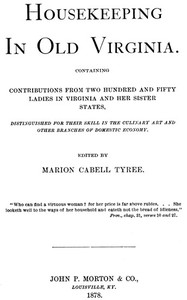
This digital edition of Housekeeping in Old Virginia — Edition Insights is described by source-level measurements including 139,537 words, 10 hr 7 min estimated reading time, and 21 detected text sections.
The text analysis averages about 12.7 words per sentence, while the detected sections provide another way to judge how the source is divided.
Project Gutenberg metadata also associates the work with “Cooking, American -- Southern style,” connecting these edition facts with the source record’s subject description.
Explore this collection
These alternatives are selected using recorded categories and estimated reading time.
About 419 minutes
Housekeeping
96,160 recorded words. 188 minutes difference from this book's estimate.
View Gutenberg source #54965About 319 minutes
Housekeeping
73,355 recorded words. 288 minutes difference from this book's estimate.
View Gutenberg source #75850About 914 minutes
Housekeeping
210,005 recorded words. 307 minutes difference from this book's estimate.
View Gutenberg source #24790Search stored excerpts and compare books → Choose by your preferences →
Choices use stored catalog measurements. Estimates vary with reading speed. A shared category is a catalog label, not a claim that two books have the same argument or literary quality.
Search reads excerpt text stored with this catalog and links to its associated Gutenberg record. The connection is stored in the site database; this tool does not recheck that every excerpt is word-for-word identical to that external record. Excerpt search does not cover every chapter and does not verify historical publication dates.
Catalog snapshot checked: 2026-09-26. Coverage: 91 public books, 91 available source excerpts.
Calculated from edition completeness, EPUB availability, text structure and catalogue metadata. Not a user rating.
Total of 100 points, scaled to a 2.5-5.0 range. Editions with an empty description or a missing EPUB file are not scored.
Public-domain source text
The source text is kept in the dedicated reader, separate from this catalogue record and its commentary.
Housekeeping in Old Virginia opens with a preface that frames domestic economy as a patriotic act, tracing Virginia's culinary reputation to colonial governors and royalist exiles. The editor, Marion Cabell Tyree, then presents over 250 contributors—named ladies from Virginia and sister states—whose recipes fill 21 sections ranging from bread to sick-room remedies. The book's structure is practical: each recipe is attributed to its contributor, creating a patchwork of individual voices within a shared regional identity.
The excerpts show a text dense with precise measurements and specific techniques. Recipes for tomato pickles, for instance, call for puncturing tomatoes with a thorn or straw, scalding in ginger tea, or layering with salt for twelve hours. Such details suggest a readership familiar with preserving but requiring exact guidance. The language is direct, often imperative: "Mix thoroughly and boil till done."
The book's most striking feature is its chorus of named contributors. Each recipe is signed with an abbreviation like "Mrs. S. T. Green" or "Mrs. P. McG.," turning the volume into a community document. This attribution creates a sense of shared expertise: a reader can imagine a network of women exchanging methods for green tomato sauce or Hyden salad. The preface reinforces this by dedicating the work to "the sister housekeepers" whose assistance lightened the editor's labors.
The collaborative structure also introduces variation. Multiple recipes for the same dish—such as three versions of "Sweet Tomato Pickle"—allow comparison. One calls for scalding tomatoes in ginger tea until clear; another boils them for ten minutes. These differences hint at personal preferences and local traditions, preserved without editorial flattening. The result is a text that feels alive with multiple voices, each contributing a distinct approach.
The recipes demand exact measurement and timing. Ingredients are listed in specific quantities: "3 gills white mustard-seed," "2 quarts brown sugar," "1 pint onions, chopped fine." Instructions often include steps like "let them stand twelve hours" or "boil until thick as marmalade," relying on visual and tactile cues. The language is imperative and concise: "Mix thoroughly and boil till done."
This precision extends to equipment and technique. One pickle recipe instructs to "puncture the tomato with a thorn or straw" before layering with salt. Another specifies "scald in strong ginger tea until clear." Such details reveal a hands-on approach to preservation, where the cook must observe and adjust. The book assumes a well-stocked kitchen—with spices like mace, cloves, and celery-seed—but also offers workarounds, like using molasses instead of sugar in some pickles.
While the title emphasizes Virginia, the contributors come from "her sister states" as well. The preface roots the cuisine in colonial history, citing "royal colonial governors" and "adherents of King Charles" who brought "the graces and luxuriousness of his brilliant court." This origin story frames Southern hospitality as a legacy worth preserving, even as the recipes themselves are practical and economical.
The ingredients reflect a regional larder: tomatoes, cabbage, green peppers, onions, and spices like ginger and turmeric appear frequently. Recipes for "Hyden Salad" and "Brunswick Stews" point to local dishes, while the inclusion of "Coffee, Tea, and Chocolate" and "Wines" suggests a broader domestic repertoire. The book thus balances local identity with a wider Southern scope, offering a snapshot of late-19th-century household management that is both specific and representative.
Readers approaching this text should attend to the variations between recipes for the same dish—they reveal the flexibility within tradition. The book rewards browsing: its structure invites comparison of methods, from scalding times to spice ratios. As a record of domestic knowledge, it offers insight into the rhythms of a 19th-century kitchen, where precision and resourcefulness went hand in hand.
I remember my grandmother’s hand—inked loops on a stained page, her recipe for crabapple jelly. Those Virginia women’s precise notes feel just like her margins. And I find the same careful intimacy in The Queen-like Closet or Rich Cabinet Stored with all manner of rare receipts for preserving, candying and cookery. Very pleasant and beneficial to all ingenious — Story, Setting & Ideas; that old book whispers the same quiet, female solidarity from centuries away.
Save your reaction, strongest insight, and memorable passage.