Family fare — Story, Setting & Ideas
Edition facts
The source record for Family fare — Story, Setting & Ideas measures this digital text at 29,671 words, 2 hr 10 min estimated reading time, and 19 detected text sections.
The text analysis averages about 13.7 words per sentence, while the detected sections provide another way to judge how the source is divided.
Project Gutenberg metadata also associates the work with “Food,” connecting these edition facts with the source record’s subject description.
Calculated from edition completeness, EPUB availability, text structure and catalogue metadata. Not a user rating.
How this score is calculated
- Description quality20 pts
- Title & short description10 pts
- Source metadata20 pts
- Text length15 pts
- Chapters / structure15 pts
- EPUB file integrity20 pts
Total of 100 points, scaled to a 2.5-5.0 range. Editions with an empty description or a missing EPUB file are not scored.
Read the Text
Transcriber’s Note Italic text displayed as: _italic_ Bold text displayed as: =bold=
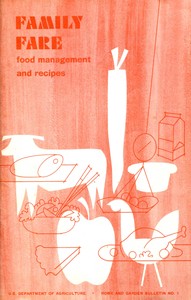
FAMILY FARE food management and recipes
U.S. DEPARTMENT OF AGRICULTURE · HOME AND GARDEN BULLETIN NO. 1
Nutrition ... food at work for you 2 A guide to eat by 2 How to use the guide 3 Maintaining desirable weight 6 Tips on meal planning 6 Servings and pounds 7 Meat, poultry, and fish 7 Vegetables and fruits 7 Smart buying 8 Meat 8 Poultry 9 Fish 10 Eggs 11 Fresh fruits and vegetables 11 Canned and frozen foods 14 Wise storing 14 Meat, poultry, and fish 14 Eggs 14 Fresh fruits and vegetables 14 Fats and oils 15 Canned, frozen, and dried foods 15 Ingredients and measurements 16 About ingredients 16 Measuring foods 16 Main dishes 18 Meat 18 Poultry 26 Fish 32 Eggs, cheese, and dry beans 36 Vegetables 42 Fresh vegetables 42 Frozen and canned vegetables 42 Serving boiled vegetables 43 Salads and salad dressings 49 Tips on salad making 49 Tips on dressings 49 Salad go-togethers 49 Soups 54 Sauces and gravies 57 White sauce 57 Gravy 57 Breads and sandwiches 59 Hot breads 59 Sandwiches 62 Desserts 64 Ways to use leftovers 74 Cooking terms 76 Index to recipes 78
Human Nutrition Research Division and Consumer and Food Economics Research Division Agricultural Research Service
Acknowledgment is made to Fish and Wildlife Service, U.S. Department of the Interior, for contributions to this publication.
Washington, D.C. Revised April 1968
For sale by the Superintendent of Documents, U.S. Government Printing Office Washington, D.C. 20402—Price 30 cents
food management and recipes
Whether you are just learning the skills of food management and good cooking or are an experienced hand in the kitchen, this booklet—prepared by USDA food and nutrition scientists—can serve you well.
It combines good eating and good nutrition. It packs the results of years of food and nutrition research into a ready handbook for everyday use. It tells how to get the nutrients you need from a variety of foods—then translates this knowledge into taste-tested recipes and well-balanced meals.
Feeding your family well takes less time and work than it used to. Today’s foods can have built-in convenience. Meals can be more varied because more food choices are available.
In this publication you’ll find—
• A daily food guide—a simple, workable presentation of the kinds and amounts of foods to have each day.
• Tips on meal planning.
• Helpful information on buying, storing, measuring, and using foods.
• A selection of recipes—main dishes, vegetables, salads, soups, sauces, breads, sandwiches, desserts—plus variations of some of these recipes.
• A list of cooking terms.
Nutrition is the food you eat and how the body uses it.
People differ in how much they want to know about nutrition, but everyone needs to know a few facts about food and health as a basis for selecting the foods to eat.
You need food to get energy for work and play, to move, to breathe, to keep the heart beating—just to be alive. Children and youths need energy from food for growth.
Food also provides a variety of substances—nutrients—that are essential for the building, the upkeep, and the repair of body tissues, and for the efficient functioning of the body.
Everyone needs the same nutrients throughout life but in different amounts. Proportionately greater amounts are required for the growth of a body than just for its upkeep. Boys and men need more energy and nutrients than girls and women. Large people need more than small people. Active people require more food energy than inactive ones. People recovering from illness need more than healthy people.
You and your family can get all the nutrients you need from foods, but no one food contains all the nutrients in the amounts required for growth and health. Only a variety of different kinds of foods will supply all you need.
Nutrition scientists have translated knowledge of the nutrient needs of people and the nutritive values of foods into an easy-to-use guide for food selection.
This Daily Food Guide, on pages 4 and 5, sorts foods into four groups on the basis of their similarity in nutrient content. Each of the broad food groups has a special contribution to make toward an adequate diet.
Here are some of the reasons different food groups are emphasized in the guide and the names of some of the nutrients these foods provide.
Meat, poultry, fish, and eggs from the _meat group_ and their alternates—dry beans, dry peas, and nuts—are valued for their protein. This is needed for the growth and repair of body tissues—muscle, organs, blood, skin, and hair. These foods also contribute iron and the B-vitamins—thiamine, riboflavin, and niacin.
The opening pages of Family Fare establish a clear structural pattern: a daily food guide leads into meal planning, then buying, storing, and finally recipes grouped by course. This progression from principle to practice recurs throughout, as each section—whether on vegetables, salads, or desserts—begins with general tips before offering specific instructions. The boiling guide for fresh vegetables, for instance, lists times in a table, then immediately suggests serving options: creamed, chilled in salads, or with a sauce. That movement from data to application is the booklet’s signature.
From Nutrition to the Kitchen Counter
The booklet opens with a section titled “Nutrition … food at work for you,” then moves to “A guide to eat by” and “Tips on meal planning.” This sequence is not arbitrary; it mirrors the USDA’s aim to ground cooking choices in nutritional science. The guide itself is a simple daily checklist of food groups, but the text quickly translates it into servings and pounds—for example, “Meat, poultry, and fish” and “Vegetables and fruits” each get a short table. The effect is a steady zoom from abstract recommendations to concrete quantities. Later sections repeat this pattern: “Smart buying” lists cuts of meat and signs of freshness, then “Wise storing” gives temperature and timing rules. The structure trains the reader to think in stages: plan, shop, store, cook.
Vegetables: A Case Study in Methodical Variety
The vegetable section exemplifies the booklet’s layered approach. It opens with a boiling-time table—asparagus whole 10–20 minutes, spinach 3–10—then immediately offers four serving styles: creamed, chilled in salads, with a sauce, or panned. Each method gets its own recipe block. For creamed vegetables, the text gives both a from-scratch method (3 cups vegetable with 1½ cups medium white sauce) and a shortcut using condensed soup. The panning technique is described step by step: heat fat, add shredded cabbage or sliced carrots, sprinkle salt, add water, cover, cook low. Times are precise—cabbage 6–8 minutes, carrots about 10, corn 15–18. Variations suggest adding onion, bacon, or ham. This section moves from general guidance to specific, repeatable actions.
Recipes as Modular Building Blocks
Recipes in Family Fare are designed to be combined. The white sauce recipe on page 57, for instance, appears in multiple contexts: as a base for creamed vegetables, as a component of soufflés, and as a starting point for cheese sauce or mock hollandaise. The spinach soufflé recipe calls for medium white sauce made from flour, milk, fat, and seasonings, then adds cooked spinach and beaten egg whites. The method—make sauce, cool slightly, fold in whites, bake in a water bath—is typical of the booklet’s precise, numbered instructions. Similarly, broiled tomatoes are simply cut, seasoned, topped with breadcrumbs, and broiled. These recipes are not showpieces; they are interchangeable parts for building meals.
The Recurring Image of the Well-Stocked Pantry
Throughout the text, certain ingredients and tools reappear: butter or margarine, flour, milk, salt, pepper, and a heavy pan with a tight lid. The panning method for vegetables depends on that heavy pan and controlled steam. The white sauce recipe insists on stirring constantly. The soufflé requires a greased casserole set in hot water. These recurring details create a consistent kitchen vocabulary. The booklet also returns to the idea of leftovers: a separate section lists ways to use them, and many recipes include variations that incorporate cooked meat or vegetables. The overall structure—moving from nutrition to shopping to storage to cooking to leftovers—suggests a closed loop of food management, where nothing is wasted.
Family Fare is best read as a reference, not a narrative. Its value lies in the tables and cross-references: the boiling guide, the sauce pairings, the substitution notes. A reader might start with the daily food guide, then jump to a specific recipe, then check the cooking terms glossary. The booklet rewards that kind of nonlinear use. Pay attention to the recurring techniques—panning, creaming, saucing—and you will see how a few basic methods can produce a wide range of dishes.
That 1968 bulletin knew its way around a kitchen, calm as a timer ticking. Its precise boiling times and plain sauces feel like steady advice from a neighbor who has fed many. It sits well beside Housekeeping in Old Virginia, which shares that unhurried confidence. Both understand that feeding people is, at heart, a quiet ritual of care—one measured in washed pots and remembered tables. Housekeeping in Old Virginia — Edition Insights keeps that older wisdom within reach, like a familiar shelf worn smooth by long handling.

There are no reviews for this eBook.
Record your reading impressions
A brief reflection can help important ideas stay with you longer.