About 738 minutes
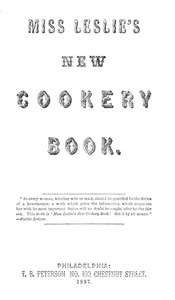
Miss Leslie's New Cookery Book — Key Ideas to Explore
Historical Cookbooks
169,658 recorded words. 18 minutes difference from this book's estimate.
View Gutenberg source #40943
The catalog record for Miss Leslie's Complete Cookery Directions for Cookery, in Its Various Branches — Themes and Context provides practical reading context through 165,475 words, 12 hr estimated reading time, and 23 detected text sections.
The text analysis averages about 15.9 words per sentence, while the detected sections provide another way to judge how the source is divided.
Project Gutenberg metadata also associates the work with “Cooking, American,” connecting these edition facts with the source record’s subject description.
Explore this collection
These alternatives are selected using recorded categories and estimated reading time.
About 738 minutes
Historical Cookbooks
169,658 recorded words. 18 minutes difference from this book's estimate.
View Gutenberg source #40943About 643 minutes
Historical Cookbooks
147,735 recorded words. 77 minutes difference from this book's estimate.
View Gutenberg source #22790About 967 minutes
Historical Cookbooks
222,201 recorded words. 247 minutes difference from this book's estimate.
View Gutenberg source #42544Search stored excerpts and compare books → Choose by your preferences →
Choices use stored catalog measurements. Estimates vary with reading speed. A shared category is a catalog label, not a claim that two books have the same argument or literary quality.
Search reads excerpt text stored with this catalog and links to its associated Gutenberg record. The connection is stored in the site database; this tool does not recheck that every excerpt is word-for-word identical to that external record. Excerpt search does not cover every chapter and does not verify historical publication dates.
Catalog snapshot checked: 2026-09-26. Coverage: 91 public books, 91 available source excerpts.
Calculated from edition completeness, EPUB availability, text structure and catalogue metadata. Not a user rating.
Total of 100 points, scaled to a 2.5-5.0 range. Editions with an empty description or a missing EPUB file are not scored.
Public-domain source text
The source text is kept in the dedicated reader, separate from this catalogue record and its commentary.
Eliza Leslie's Complete Cookery, in its forty-ninth edition (1853), presents itself as a thoroughly revised manual for the American kitchen. The preface directly addresses the book's practical purpose: to make 'practical housewives of young ladies' and to improve the family table. Leslie's tone is brisk and instructional, with recipes that specify exact measurements—'a quarter of a pound of white sugar,' 'a small tea-spoonful of powdered cinnamon'—and clear sequences of steps. The catalog subject 'Cooking, American' is borne out by ingredients like rice, raisins, and citron, and by the absence of European culinary terms. Yet the excerpts also reveal a work deeply concerned with domestic economy and the social role of the cook, as Leslie asserts that 'no man (or woman either) ought to be incapable of distinguishing bad eatables from good ones.'
The excerpts show Leslie's commitment to exact quantities and procedures. In the rice plum pudding, she directs the cook to 'dredge them well with flour, to prevent their sinking'—a specific technique for handling dried fruit. The boiled rice pudding requires 'a quarter of a pound of ground rice' simmered 'over hot coals; stirring it all the time to prevent its being lumpy.' These details are not generic; they reflect a hands-on understanding of common kitchen failures. Leslie also distinguishes between similar dishes: a 'plain rice pudding' uses eggs, while a 'farmer's rice pudding' is 'made without eggs,' relying instead on 'rich milk, or of cream and milk mixed.' Such variations suggest a readership that might adjust recipes based on available ingredients or dietary preferences. The instructions to 'send it to table cool' or 'eat it cold' appear repeatedly, indicating that some puddings were served at room temperature, a practice that differs from modern expectations.
Leslie's preface establishes her as an expert who has 'introduced improvements, corrected errors, and added new receipts.' She reports that 'gentlemen, also, have told me of great improvements in the family-table, after presenting their wives with this manual.' This framing positions the book as a tool for domestic reform, with Leslie as the arbiter of good taste. The recipes themselves reinforce this authority through imperative verbs: 'Pick, wash, and boil,' 'Beat six eggs very light,' 'Strain it through a sieve.' There is no room for improvisation; the cook is to follow exactly. Yet Leslie also includes evaluative language: the rice plum pudding 'will be perfectly soft' if done correctly, and the boiled rice pudding should be 'thick and smooth.' These assurances guide the inexperienced cook. The repeated use of 'you may'—as in 'you may make this pudding of ground rice'—offers limited flexibility while maintaining control over the outcome.
The recipes reveal a pantry stocked with staples: rice, milk, butter, eggs, sugar, spices (nutmeg, cinnamon, mace), and dried fruit (raisins, currants, citron). Alcohol appears frequently—'a wine glass of rose water; and a wine glass of brandy or white wine'—as a flavoring and preservative. Leslie's instructions to 'send it to table cool' for many puddings suggest that dishes were prepared in advance, a practical consideration for household management. The 'farmer's rice pudding,' baked for 'two hours or more,' uses brown sugar and no eggs, implying a more economical version. The preface's claim that the book has 'made practical housewives of young ladies' ties these recipes directly to the social expectation that women manage the household efficiently. The catalog subject 'Cooking, American' is thus not merely about geography but about a specific domestic ideology: the cookbook as a tool for training women in thrift, precision, and hospitality.
Readers approaching this edition should note that it is a revision of an earlier work, with new receipts added and errors corrected. The index has been reorganized, combining two original indexes. The recipes assume a wood-fired stove or hearth, with instructions to 'set it over hot coals' and 'bake it an hour.' Leslie's voice is direct and confident, but the book is best used as a historical document of mid-19th-century American cookery rather than a modern kitchen manual. Pay attention to the specific measurements and techniques, which reveal much about the material culture of the period.
Reading Eliza Leslie’s precise, no-nonsense instructions for mid-century American kitchens, I felt the calm of order itself—her measured syllables like a slow ticking clock. It brought to mind a later, quieter volume, one where paper envelopes replace copper pots. Same underlying domestic kindness, I suppose, only wrapped in folds of parchment. Paper-bag Cookery — Key Ideas to Explore feels like a whispered footnote to her larger, bustling story.
Create a short personal record of your experience with this book.