About 114 minutes
A little girl's cookery book — Reading Companion
Historical Cookbooks
26,145 recorded words. 1 minutes difference from this book's estimate.
View Gutenberg source #69364
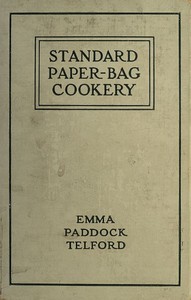
The source record for Paper-bag Cookery — Key Ideas to Explore measures this digital text at 25,841 words, 1 hr 53 min estimated reading time, and 4 detected text sections.
The text analysis averages about 21.1 words per sentence, while the detected sections provide another way to judge how the source is divided.
Project Gutenberg metadata also associates the work with “Paper bag cooking,” connecting these edition facts with the source record’s subject description.
Explore this collection
These alternatives are selected using recorded categories and estimated reading time.
About 114 minutes
Historical Cookbooks
26,145 recorded words. 1 minutes difference from this book's estimate.
View Gutenberg source #69364About 131 minutes
Historical Cookbooks
30,059 recorded words. 18 minutes difference from this book's estimate.
View Gutenberg source #49155About 134 minutes
Historical Cookbooks
30,621 recorded words. 21 minutes difference from this book's estimate.
View Gutenberg source #13669Search stored excerpts and compare books → Choose by your preferences →
Choices use stored catalog measurements. Estimates vary with reading speed. A shared category is a catalog label, not a claim that two books have the same argument or literary quality.
Search reads excerpt text stored with this catalog and links to its associated Gutenberg record. The connection is stored in the site database; this tool does not recheck that every excerpt is word-for-word identical to that external record. Excerpt search does not cover every chapter and does not verify historical publication dates.
Catalog snapshot checked: 2026-09-26. Coverage: 91 public books, 91 available source excerpts.
Calculated from edition completeness, EPUB availability, text structure and catalogue metadata. Not a user rating.
Total of 100 points, scaled to a 2.5-5.0 range. Editions with an empty description or a missing EPUB file are not scored.
Public-domain source text
The source text is kept in the dedicated reader, separate from this catalogue record and its commentary.
Countess Vera Serkoff’s 1911 Paper-bag Cookery presents a method that seals food in paper bags to cook in hot air and its own steam, claiming superior flavour and higher nutritive value. The introduction lists advantages in numbered points: food loses practically nothing in weight, cooking time is shorter, and no pots or pans need cleaning—the bags are simply burned. The author addresses both mistress and maid, noting the method’s cleanliness and its appeal when doing without a servant.
The nearly 200 recipes cover meats, fish, vegetables, and desserts. Tomato dishes appear frequently, with variations for stew, pie, and stuffed tomatoes. Vegetable marrow receives multiple treatments, including a savoury version with tomatoes and ham. Each recipe specifies bag greasing and cooking times, reflecting a systematic approach to this then-novel technique.
The introduction enumerates nine advantages, each given a number and a bold claim. Chief among them is that food cooked in a paper bag is “superior in flavour and of higher nutritive value than that cooked in any other way.” Economy is stressed: an immense saving in fuel, no loss in weight, and a weekly bag cost of at most sixpence. The method also promises convenience—the entire meal can be prepared and placed in bags overnight, and joints require no basting. Cleanliness is a recurring theme: no blackened saucepans, no dishcloths, no strong soda water to roughen hands. The bags themselves are disposable, eliminating the need for constant renewal of pots and fireproof ware.
Tomatoes appear in multiple recipes, each with a distinct technique. For Tomato Stew, the skins are removed by plunging into boiling then cold water, a method also used for the pie and stuffed tomatoes. The stew includes a bouquet of herbs—thyme, parsley, bay leaf—and grated lemon rind, cooked twenty minutes in a buttered bag. Stuffed tomatoes are presented as “a very nice supper or breakfast dish,” filled with minced meat, kidney, or sausage, then brushed with oiled butter and cooked in a greased “Papakuk” bag.
Vegetable marrow receives three treatments. The author notes that plainly boiled marrow is “insipid,” but paper-bag cooking transforms it. One recipe stuffs the marrow with minced onion, cooked meat, breadcrumbs, suet, and egg, tying the halves together with string. Another slices the marrow into rings, dips them in thick batter, and cooks them thirty minutes. A savoury version combines marrow with tomatoes, onions, lemon juice, ham, and breadcrumbs bound with egg yolk.
The front matter includes an advertisement for McDougall’s Self Raising Flour, touting its 40-year reputation and suitability for pastry and puddings. The recipes themselves call for “Papakuk” bags, a branded paper bag presumably sold for this purpose. The author instructs readers to grease these bags thickly with butter, suggesting that the bag’s quality is integral to success. The introduction’s claim that an ample supply of bags costs at most sixpence per week positions the method as economical, yet the reliance on a specific product hints at a commercial underpinning. The cookbook thus balances a promise of thrift with the promotion of specialized materials.
Readers should note that the excerpts provide only a portion of the recipes and the full introduction. The method’s claims about nutrition and flavour are stated but not independently verified here. The recipes are detailed and assume a gas oven with controlled heat to prevent scorching the bags. Those interested in early 20th-century domestic innovation will find this a focused example of how convenience was marketed alongside traditional cooking values.
There’s something tender about a 1911 book that trusts a paper bag to hold a whole dinner, sealing in steam and silence. It makes me think of that other old volume, meant for men learning their way around a kitchen, where the clumsiness feels human. I kept both on my shelf, side by side, two quiet voices from another century. The Stag Cook Book: Written for Men by Men — Key Ideas to Explore sits there too, like a familiar postcard, not asking anything of me.
Build a private reading journal entry for this title.