About 168 minutes
Practical vegetarian cookery — Edition Insights
Historical Cookbooks
38,485 recorded words. 5 minutes difference from this book's estimate.
View Gutenberg source #69812
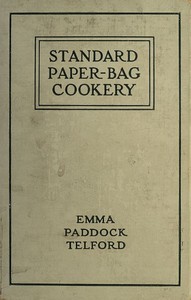
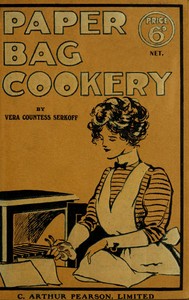
For Standard Paper-Bag Cookery — Edition Insights, the stored edition analysis reports 39,680 words, 2 hr 53 min estimated reading time, and 7 detected text sections.
The text analysis averages about 18.3 words per sentence, while the detected sections provide another way to judge how the source is divided.
Project Gutenberg metadata also associates the work with “Paper bag cooking,” connecting these edition facts with the source record’s subject description.
Explore this collection
These alternatives are selected using recorded categories and estimated reading time.
About 168 minutes
Historical Cookbooks
38,485 recorded words. 5 minutes difference from this book's estimate.
View Gutenberg source #69812About 145 minutes
Historical Cookbooks
33,236 recorded words. 28 minutes difference from this book's estimate.
View Gutenberg source #48695About 142 minutes
Historical Cookbooks
32,553 recorded words. 31 minutes difference from this book's estimate.
View Gutenberg source #67482Search stored excerpts and compare books → Choose by your preferences →
Choices use stored catalog measurements. Estimates vary with reading speed. A shared category is a catalog label, not a claim that two books have the same argument or literary quality.
Search reads excerpt text stored with this catalog and links to its associated Gutenberg record. The connection is stored in the site database; this tool does not recheck that every excerpt is word-for-word identical to that external record. Excerpt search does not cover every chapter and does not verify historical publication dates.
Catalog snapshot checked: 2026-09-26. Coverage: 91 public books, 91 available source excerpts.
Calculated from edition completeness, EPUB availability, text structure and catalogue metadata. Not a user rating.
Total of 100 points, scaled to a 2.5-5.0 range. Editions with an empty description or a missing EPUB file are not scored.
Public-domain source text
The source text is kept in the dedicated reader, separate from this catalogue record and its commentary.
Emma Paddock Telford's Standard Paper-Bag Cookery (1912) presents itself as a guide to a specific cooking method, yet the excerpts reveal a curious tension between the book's stated purpose and its actual content. The catalog subject "Paper bag cooking" suggests a focus on that technique, but the provided text devotes far more space to conventional sauce recipes—such as Hollandaise, Curry, and Spanish sauces—than to instructions for cooking in paper bags. The foreword emphasizes "practicability" and aims to minimize labor for the housewife, but the sauce section reads like a standard early-20th-century cookbook, with detailed proportions and techniques that do not involve paper bags at all.
The excerpts include a lengthy section on sauces—Hollandaise, Horseradish, Mint, and others—that are prepared in saucepans, not paper bags. This raises questions about how central the paper-bag method truly is to the book. The foreword explicitly states that soups, omelettes, and macaroni are better done by other methods, suggesting a selective application of the technique. Yet the sauce recipes, which occupy a substantial portion of the excerpts, make no mention of paper bags. The reader might wonder: are these sauces meant to accompany paper-bag-cooked dishes, or does the book simply repurpose conventional recipes under a trendy title? The catalog subject may overstate the book's novelty.
Telford's recipe style is notably precise, with specific measurements and step-by-step instructions. For example, the Hollandaise sauce calls for butter "washed" in cold water to remove salt, then divided into three parts and added sequentially. The Curry sauce specifies a "scant tablespoonful" of curry powder and warns not to let the flour-butter mixture brown. This attention to detail aligns with the foreword's promise of "clear and concise" directions. However, the excerpts also include recipes like "French Mustard Sauce, Creole Style" that blend multiple culinary traditions (mustard, sugar, egg, vinegar, olive oil), reflecting the eclectic tastes of the era. The practical tone is consistent, but the content often strays from the paper-bag premise.
The foreword addresses "the woman who does her own work" and the "epicurean but frugal housewife," indicating a target audience of middle-class homemakers seeking efficiency. Yet the sauce recipes assume access to ingredients like curry powder, olive oil, and fresh herbs—not universally available in 1912. The book also includes a "Time Table" and chapters on "Paper Bag Menus" and "Easiest Dishes for Beginners," suggesting a structured approach. However, the excerpts do not show these sections, leaving the reader to infer how the paper-bag method integrates with the broader recipe collection. The catalog subject may accurately reflect the book's intent, but the evidence suggests a more conventional cookbook with a specialized gimmick.
Readers approaching Standard Paper-Bag Cookery should be prepared for a cookbook that often sets aside its titular method in favor of standard sauce and dish preparations. The excerpts hint at a work that is more about general early-20th-century cooking than a revolutionary technique. To fully assess the book's claim, one would need to examine the chapters on actual paper-bag cooking—such as those on fish, poultry, and vegetables—which are not included here. The sauce section, while detailed and practical, may not satisfy those seeking a focused guide to paper-bag cookery.
There’s something tender about old cookbooks like Emma Telford’s, where efficiency feels almost hopeful. I found myself thinking how her paper-bag tricks—meant to free a housewife’s hours—echo the quiet thoroughness of Mrs. Beeton's Dictionary of Every-Day Cookery The "All About It" Books — Reading Notes. Both speak to a slower time when even the smallest kitchen secret was a small, private victory.
Save your reaction, strongest insight, and memorable passage.