About 142 minutes
A Handbook of Cookery for a Small House — Text and Context
Historical Cookbooks
32,553 recorded words. 3 minutes difference from this book's estimate.
View Gutenberg source #67482
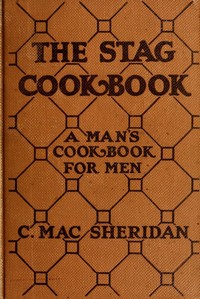
For The Stag Cook Book: Written for Men by Men — Key Ideas to Explore, the stored edition analysis reports 33,236 words, 2 hr 25 min estimated reading time, and 6 detected text sections.
The text analysis averages about 18.0 words per sentence, while the detected sections provide another way to judge how the source is divided.
Project Gutenberg metadata also associates the work with “Cooking,” connecting these edition facts with the source record’s subject description.
Explore this collection
These alternatives are selected using recorded categories and estimated reading time.
About 142 minutes
Historical Cookbooks
32,553 recorded words. 3 minutes difference from this book's estimate.
View Gutenberg source #67482About 134 minutes
Historical Cookbooks
30,621 recorded words. 11 minutes difference from this book's estimate.
View Gutenberg source #13669About 131 minutes
Historical Cookbooks
30,059 recorded words. 14 minutes difference from this book's estimate.
View Gutenberg source #49155Search stored excerpts and compare books → Choose by your preferences →
Choices use stored catalog measurements. Estimates vary with reading speed. A shared category is a catalog label, not a claim that two books have the same argument or literary quality.
Search reads excerpt text stored with this catalog and links to its associated Gutenberg record. The connection is stored in the site database; this tool does not recheck that every excerpt is word-for-word identical to that external record. Excerpt search does not cover every chapter and does not verify historical publication dates.
Catalog snapshot checked: 2026-09-26. Coverage: 91 public books, 91 available source excerpts.
Calculated from edition completeness, EPUB availability, text structure and catalogue metadata. Not a user rating.
Total of 100 points, scaled to a 2.5-5.0 range. Editions with an empty description or a missing EPUB file are not scored.
Public-domain source text
The source text is kept in the dedicated reader, separate from this catalogue record and its commentary.
The Stag Cook Book opens with a dedicatory poem that sets a defiant, self-deprecating tone: men, left to their own devices in a kitchenette, can produce dishes that “will put any cook on her mettle.” This verse, followed by Robert H. Davis’s introduction, frames cooking as a masculine gift rather than a learned art. The excerpts reveal a collection that oscillates between boastful asides and surprisingly precise instructions—Captain Edward A. Salisbury’s spaghetti sauce, for instance, specifies boiling spaghetti for exactly twenty-three minutes and rinsing with cold water to “remove all gumminess.” The voice is confident, occasionally profane, and rooted in a 1920s bachelor subculture.
The book’s editorial voice is established early through its dedication and introductory poem, which mock feminine “raillery and sarcasm” while insisting that men cook with “art—and real food value—in it.” This combative, self-justifying tone recurs in the recipes. Captain Salisbury’s venison steak instructions, for example, declare that his method is “really the only way to cook it that’s worth a damn.” Such language is not merely colorful; it signals the book’s intended audience—bachelors and benedicts who have faced domestic skepticism. The voice is consistently first-person and anecdotal, as when Salisbury describes learning his spaghetti sauce “in Italy.” This personal, almost boastful narration contrasts with the precise, almost scientific details that follow, creating a distinctive hybrid of swagger and specificity.
Despite the casual tone, many recipes demand exacting techniques. Salisbury’s spaghetti sauce requires dried mushrooms soaked for “about a half hour,” tomatoes stewed for thirty minutes, and a final steep of one hour after adding chili powder or Worcestershire sauce with bouillon cubes. The spaghetti itself must boil for exactly twenty-three minutes, then be rinsed under cold water—a step he calls “important” for removing gumminess. Similarly, the recipe for Burachki (beets à la Polonaise) specifies “one level tablespoonful of butter, and one tablespoonful of flour” browned to “a golden hue.” These measurements and timings suggest that the contributors, many of whom were likely amateur cooks, valued reproducibility. The blend of casual boasting and careful instruction gives the book a practical, if idiosyncratic, authority.
The recipes reflect the domestic technology and pantry of the early 1920s. Ingredients like Mazola oil, Lea & Perrins sauce, Eagle Chili Powder, and cooking Sherry appear frequently. The equipment mentioned—Dutch ovens, frying pans, sieves, colanders—is basic, and the cooking environments range from “camp fires” to “small kitchenette[s]” to “huge” tiled kitchens, as the introductory poem lists. The fish recipe calls for a “six pound bass” and instructs the cook to insert garlic cloves into slits in the flesh, then cover the fish with sliced onions, peppers, and tomatoes. This rustic, hearty style aligns with the book’s masculine marketing. The absence of elaborate sauces or complex techniques (except in timing) suggests a no-nonsense approach, though the inclusion of a wine glass of Sherry for basting shows a willingness to use alcohol as a flavoring agent.
The Stag Cook Book is best approached as a period artifact rather than a modern kitchen manual. Readers interested in early twentieth-century foodways, gender roles, or the history of cookbook publishing will find its blend of bravado and precision revealing. The recipes are usable, but the real value lies in the voice—a snapshot of how cooking was marketed to men in 1922. For a full picture, compare the contributors’ styles: some are terse, others chatty, and the editorial hand is light.
That rainy afternoon, the swaggering boasts in The Stag Cook Book made me smile, yet their little precise flourishes—a pinch here, a flame turned low—hinted at older mysteries beneath the bluster. My hand drifted to my shelf, almost by accident, and settled on The accomplisht cook or, The art & mystery of cookery — Reading Companion. Its quiet, methodical pages felt like a deeper, calmer whisper behind the campfire noise.
Build a private reading journal entry for this title.