About 173 minutes
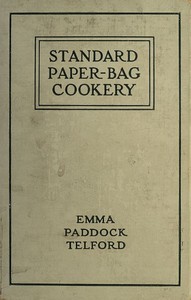
Standard Paper-Bag Cookery — Edition Insights
Historical Cookbooks
39,680 recorded words. 5 minutes difference from this book's estimate.
View Gutenberg source #42955
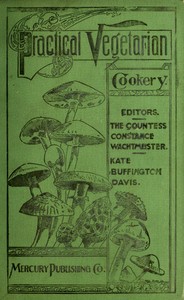
The source record for Practical vegetarian cookery — Edition Insights measures this digital text at 38,485 words, 2 hr 48 min estimated reading time, and 56 detected text sections.
The text analysis averages about 21.2 words per sentence, while the detected sections provide another way to judge how the source is divided.
Project Gutenberg metadata also associates the work with “Vegetarian cooking,” connecting these edition facts with the source record’s subject description.
Explore this collection
These alternatives are selected using recorded categories and estimated reading time.
About 173 minutes
Historical Cookbooks
39,680 recorded words. 5 minutes difference from this book's estimate.
View Gutenberg source #42955About 145 minutes
Historical Cookbooks
33,236 recorded words. 23 minutes difference from this book's estimate.
View Gutenberg source #48695About 142 minutes
Historical Cookbooks
32,553 recorded words. 26 minutes difference from this book's estimate.
View Gutenberg source #67482Search stored excerpts and compare books → Choose by your preferences →
Choices use stored catalog measurements. Estimates vary with reading speed. A shared category is a catalog label, not a claim that two books have the same argument or literary quality.
Search reads excerpt text stored with this catalog and links to its associated Gutenberg record. The connection is stored in the site database; this tool does not recheck that every excerpt is word-for-word identical to that external record. Excerpt search does not cover every chapter and does not verify historical publication dates.
Catalog snapshot checked: 2026-09-26. Coverage: 91 public books, 91 available source excerpts.
Calculated from edition completeness, EPUB availability, text structure and catalogue metadata. Not a user rating.
Total of 100 points, scaled to a 2.5-5.0 range. Editions with an empty description or a missing EPUB file are not scored.
Public-domain source text
The source text is kept in the dedicated reader, separate from this catalogue record and its commentary.
Practical Vegetarian Cookery opens with an epigraph from Edwin Arnold's Light of Asia, declaring that 'knowledge grows, and life is one, / And mercy cometh to the merciful.' This moral framing, paired with the book's 1897 publication, situates it within a late-Victorian movement that linked diet to ethical and spiritual reform. The editors, Kate Buffington Davis and Countess Constance Wachtmeister, were both active in Theosophical circles, and the list of distributors includes Theosophical book concerns in San Francisco, Chicago, New York, and London.
The index alone reveals a carefully organized work: soups occupy the first ten pages, followed by savories, mushrooms, eggs, omelets, sauces, cheese dishes, and breads. The bread section, excerpted here, shows a methodical, instructional voice. Recipes like 'Baking Powder Biscuits' and 'Pop-Overs' emphasize technique—'cutting it in with bread knife,' 'beat well'—and assume a reader familiar with basic kitchen equipment but needing precise guidance.
The book's opening epigraph is not mere decoration. It establishes a clear ethical stance: vegetarianism is presented as a form of mercy, aligned with the idea that 'knowledge grows.' This moral tone is reinforced by the editors' Theosophical affiliations, which linked dietary reform to spiritual evolution. Yet the recipes themselves are resolutely practical. The preface (not fully excerpted) likely bridges this moral vision with the kitchen work that follows. The index shows no separate section for 'philosophy'—the ethical argument is condensed into the epigraph, after which the book dives into recipes. This suggests the editors expected readers already sympathetic to the cause, needing instruction rather than persuasion.
The bread recipes illustrate the book's instructional voice. Instructions are sequential and precise: 'sift together twice,' 'rub in one tablespoonful of shortening until fine, like meal,' 'cutting it in with bread knife.' The language is imperative but not condescending. The recipe for 'Pop-Overs' advises that 'the more the milk and flour are beaten the lighter the puffs will be,' revealing an understanding of underlying principles. Measurements are given in cupfuls, tablespoonfuls, and saltspoonfuls—standard for the period. The book assumes a literate cook who can follow steps but may need reminders (e.g., 'butter as soon as taken from the iron' for waffles). This voice is consistent across the excerpted recipes, suggesting a uniform editorial hand.
The index reveals a broad scope: 56 text sections covering soups, savories, mushrooms, eggs, omelets, sauces, cheese dishes, and breads. Soups alone include 25 varieties, from 'Tomato Bouillon' to 'Black Bean.' The 'Savories and Relishes' section includes 'Nut Loaf,' 'Vegetable Cutlets,' and 'Vegetable Sausages'—dishes that mimic meat textures, a common strategy in early vegetarian cookbooks. Mushrooms receive their own section, with seven recipes. The egg section offers 16 preparations, from 'Curried' to 'Swiss Eggs.' This variety suggests the book aimed to show that vegetarian cooking could be diverse and satisfying, not limited to boiled vegetables. The structure—grouping by ingredient or dish type—makes it easy to navigate.
Readers approaching this edition will find a cookbook that balances moral conviction with practical instruction. The recipes are period-specific in measurements and technique, but the underlying principles—beat well, knead thoroughly, bake in a hot oven—remain sound. The index is a useful starting point: note the emphasis on soups, eggs, and breads, and the presence of meat-substitute dishes like 'Nut Loaf' and 'Vegetable Sausages.' The book rewards a sequential reading, as techniques introduced in early sections recur later. For modern cooks, adjusting oven temperatures and ingredient availability may require experimentation, but the clear instructions provide a reliable foundation.
Leafing through the 1897 Practical Vegetarian Cookery, I find myself oddly wistful for its careful, precise bread recipes—that era’s quiet faith in method and patience. There’s a similar, homely comfort in the straightforward approach of 30 Tempting Spaghetti Meals: Easy, Economical, Delicious — Key Ideas to Explore, which feels less like innovation and more like remembering how good simple things can be.
Capture what you thought, learned, and would like to remember.