About 79 minutes
The khaki kook book — A Reader’s Guide
Historical Cookbooks
18,059 recorded words. 8 minutes difference from this book's estimate.
View Gutenberg source #25914
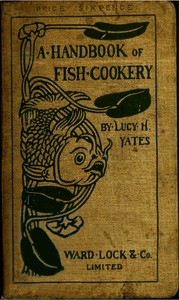
The catalog record for A Handbook of Fish Cookery: How to buy, dress, cook, and eat fish — Background and Themes provides practical reading context through 19,920 words, 1 hr 27 min estimated reading time, and 2 detected text sections.
The text analysis averages about 19.6 words per sentence, while the detected sections provide another way to judge how the source is divided.
Project Gutenberg metadata also associates the work with “Cooking (Fish),” connecting these edition facts with the source record’s subject description.
Explore this collection
These alternatives are selected using recorded categories and estimated reading time.
About 79 minutes
Historical Cookbooks
18,059 recorded words. 8 minutes difference from this book's estimate.
View Gutenberg source #25914About 73 minutes
Historical Cookbooks
16,642 recorded words. 14 minutes difference from this book's estimate.
View Gutenberg source #69334About 113 minutes
Historical Cookbooks
25,841 recorded words. 26 minutes difference from this book's estimate.
View Gutenberg source #41406Search stored excerpts and compare books → Choose by your preferences →
Choices use stored catalog measurements. Estimates vary with reading speed. A shared category is a catalog label, not a claim that two books have the same argument or literary quality.
Search reads excerpt text stored with this catalog and links to its associated Gutenberg record. The connection is stored in the site database; this tool does not recheck that every excerpt is word-for-word identical to that external record. Excerpt search does not cover every chapter and does not verify historical publication dates.
Catalog snapshot checked: 2026-09-26. Coverage: 91 public books, 91 available source excerpts.
Calculated from edition completeness, EPUB availability, text structure and catalogue metadata. Not a user rating.
Total of 100 points, scaled to a 2.5-5.0 range. Editions with an empty description or a missing EPUB file are not scored.
Public-domain source text
The source text is kept in the dedicated reader, separate from this catalogue record and its commentary.
Lucy H. Yates opens her 1897 handbook with a sharp critique of the fish trade and the modern housewife, whom she holds 'largely accountable' for high prices and waste. Her tone is brisk and opinionated, blending market analysis with culinary instruction. She notes that tons of fish are sent for manure annually, and that ignorance—especially among working-class wives—fuels aversion to cooking fish. The book is structured in four parts: choosing and buying, cooking, tested recipes, and fish sauces, reflecting a systematic approach to a neglected subject.
Yates begins not with a recipe but with a lesson in fish economics. She observes that English fish still holds the best part of the market, despite foreign imports and the disregard for 'fence months'—closed seasons for fishing. Her language is direct: 'the foreigner rarely keeps very closely to the laws of fence months,' implying a competitive advantage through rule-breaking. She argues that greater demand would lower prices and increase variety, and she blames the housewife's ignorance for perpetuating a risky trade. This opening establishes Yates as a practical, reform-minded writer who sees cookery as part of a larger economic system.
Yates's instructions are exacting. For pike, she directs the cook to 'scrape briskly with the back of a knife' after plunging the fish into cold water, then fill the cavity with 'nicely seasoned forcemeat' and sew up the sides. She specifies a moderate oven, frequent basting, and a sauce thickened with flour, anchovy sauce, mushroom ketchup, and capers. For plaice, she recommends cutting fillets, dipping them in egg and raspings, and serving each on fried bread with a 'tiny pat of anchovy butter.' The detail extends to boiling: a slit down the back prevents the white side from breaking, and a teacupful of vinegar is added to the water.
Throughout the recipes, Yates offers practical substitutions. For baking pike, she notes that 'good beef dripping will answer as well as butter.' In the plaice au gratin recipe, she uses beef dripping for the initial melt and layers crumbs with suet, parsley, shallots, and seasoning. Her approach is thrifty: leftover boiled pike can be dipped in egg and breadcrumbs and fried, served with spinach or salad. The prawn soup recipe calls for fifty prawns, with the bodies stewed in wine and pressed through a colander, while the tails are picked out separately. These details reveal a cook mindful of waste and cost.
Yates writes for a middle-class housewife whom she assumes is both ignorant and capable of improvement. She uses the second person sparingly, preferring declarative statements: 'The poorer classes still regard fish as nothing to make a meal of.' Her tone is authoritative but not condescending, and she assumes the reader has access to ingredients like anchovy butter, mushroom ketchup, and white wine. The book is part of a series by Mrs. Beeton's publisher, and Yates's own previous work, The Profession of Cookery from a French Point of View, is advertised on the title page, signaling her credentials as a serious culinary writer.
Yates's handbook rewards readers who appreciate precise, opinionated instruction grounded in market realities. Her voice is that of a practical educator who expects the cook to understand both the economics of fish and the techniques for preparing it. The recipes are specific enough to follow, yet flexible in their allowances for substitution. This is not a generic collection but a focused guide from a writer who knew her subject and her audience.
Sometimes a cookbook stays with you less for the recipes than for the quiet authority in its voice. Lucy Yates’s handling of fish felt that way—practical, almost tender about thrift. I found the same honest warmth in 30 Tempting Spaghetti Meals: Easy, Economical, Delicious — Key Ideas to Explore, as if both authors were calmly reminding us that economy and care belong together in a kitchen.
Capture what you thought, learned, and would like to remember.