About 79 minutes
The khaki kook book — A Reader’s Guide
Historical Cookbooks
18,059 recorded words. 6 minutes difference from this book's estimate.
View Gutenberg source #25914
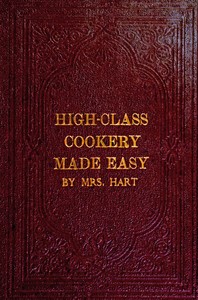
Before opening High-class cookery made easy — Themes and Context, the edition data offers a quick orientation: 16,642 words, 1 hr 13 min estimated reading time, and 19 detected text sections.
The text analysis averages about 20.0 words per sentence, while the detected sections provide another way to judge how the source is divided.
Project Gutenberg metadata also associates the work with “Cooking, British,” connecting these edition facts with the source record’s subject description.
Explore this collection
These alternatives are selected using recorded categories and estimated reading time.
About 79 minutes
Historical Cookbooks
18,059 recorded words. 6 minutes difference from this book's estimate.
View Gutenberg source #25914About 87 minutes
Historical Cookbooks
19,920 recorded words. 14 minutes difference from this book's estimate.
View Gutenberg source #53525About 37 minutes
Historical Cookbooks
8,337 recorded words. 36 minutes difference from this book's estimate.
View Gutenberg source #65327Search stored excerpts and compare books → Choose by your preferences →
Choices use stored catalog measurements. Estimates vary with reading speed. A shared category is a catalog label, not a claim that two books have the same argument or literary quality.
Search reads excerpt text stored with this catalog and links to its associated Gutenberg record. The connection is stored in the site database; this tool does not recheck that every excerpt is word-for-word identical to that external record. Excerpt search does not cover every chapter and does not verify historical publication dates.
Catalog snapshot checked: 2026-09-26. Coverage: 91 public books, 91 available source excerpts.
Calculated from edition completeness, EPUB availability, text structure and catalogue metadata. Not a user rating.
Total of 100 points, scaled to a 2.5-5.0 range. Editions with an empty description or a missing EPUB file are not scored.
Public-domain source text
The source text is kept in the dedicated reader, separate from this catalogue record and its commentary.
Mrs. J. Hart opens High-class cookery made easy with a blunt directive: “great pains must be taken to have all pans and dishes scrupulously clean.” This insistence on hygiene, including a method for cleaning copper pans with lemon skins and salt, sets the tone for a book that treats kitchen fundamentals as non-negotiable. The prefatory note reveals Hart’s background running practical cooking classes, and her aim to provide a “simple guide” for “Young Ladies and inexperienced Cooks.” Unlike many contemporary cookery books, she claims her recipes have been “proved by cooking them for the ladies,” lending a tested, classroom-tested authority to the instructions that follow.
The book’s opening pages do not begin with a recipe but with a detailed cleaning regimen. Hart instructs readers to boil lemon skins in salt water for copper pans, rinse with cold water, and dry with a linen cloth. For ordinary pans, she recommends washing soda and hot water, then a light rub with ashes. She adds a pointed note: “Keep a pan for omelets only.” This early emphasis on scrupulous cleanliness—down to “the smallest speck of dirt”—frames cooking as a discipline where preparation matters as much as the final dish. The advice is practical and specific, reflecting Hart’s experience teaching novices who might overlook such basics.
Hart declares that “the first duty of the cook or housekeeper is to have a stock made ready for soups, gravies, and sauces.” She provides a recipe for brown soup stock using a nap-bone (likely a knucklebone), broken into small pieces, washed in salt and water, and browned with onion. The method calls for eight quarts of cold water and slow simmering. This stock is then used for multiple soups, a thrifty approach suited to “economical households.” The section on sauces for joints—including horse-radish, caper, onion, apple, bread, parsley, and mint sauces—demonstrates how a single stock can be varied with simple additions like capers, vinegar, or fresh herbs.
Hart’s recipes often combine modest ingredients with careful presentation. In “Strawberry Toasts,” bread strips are soaked in egg and milk, fried in butter, then sandwiched with strawberries and arranged “in the form of a lattice-work on a folded napkin.” The “Hollandaise Pudding” uses stale bread, sponge cake crumbs, macaroons, and water biscuits, bound with eggs and milk, then steamed and ornamented with green angelica. These dishes reflect a domestic economy that repurposes leftovers while still aiming for an attractive table. The instructions are precise: “Try if cooked in the centre with a knife” appears repeatedly, a teacher’s cue for doneness.
Throughout the excerpts, Hart’s voice is direct and instructional. She uses imperatives—“Procure,” “Cut off,” “Place,” “Stir”—and addresses the reader as “you” only implicitly. The recipes are concise, often listing ingredients in the method rather than as a separate list. Her concern for the inexperienced cook is evident in warnings: for roast leg of mutton, she insists it be served with brown sauce, “not water, for it takes the juice away.” The inclusion of Worcestershire sauce, Harvey sauce, and chili vinegar in entrée sauces suggests a pantry familiar with bottled condiments, while the “American paste” for rabbit pie hints at transatlantic influence. Hart’s book is a practical manual, not a literary work, but its voice is consistent and purposeful.
Reading High-class cookery made easy sequentially reveals a deliberate pedagogical structure: from cleaning and stock to soups, fish, made-dishes, entrées, sauces, joints, puddings, and cakes. The later sections on puddings and savoury dishes show Hart’s range, but the core lessons remain those of the opening pages—cleanliness, careful stock, and tested recipes. A first-time reader might best approach the book by starting with the cleaning instructions and stock recipe, then sampling recipes from different sections to see how the same principles recur. The book rewards attention to detail, not speed.
Reading Mrs. Hart's insistence on scrupulously clean pans, I thought of the quiet patience in old cookbooks, how they assume a young lady has time to learn. I sometimes flip through Miss Leslie's New Cookery Book — Key Ideas to Explore the same way, wondering who once owned these pages and what their first pudding looked like.
Use these questions to collect your thoughts before moving on.