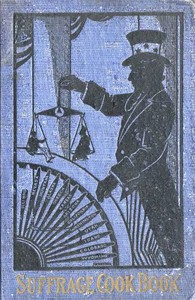
About 139 minutes
The Suffrage Cook Book — Reading Notes
Recipes
31,787 recorded words. 5 minutes difference from this book's estimate.
View Gutenberg source #26323
For A little cook book for a little girl — Inside the Classic, the stored edition analysis reports 30,598 words, 2 hr 14 min estimated reading time, and 4 detected text sections.
The text analysis averages about 17.4 words per sentence, while the detected sections provide another way to judge how the source is divided.
Project Gutenberg metadata also associates the work with “Cooking -- Juvenile literature,” connecting these edition facts with the source record’s subject description.
Explore this collection
These alternatives are selected using recorded categories and estimated reading time.
About 139 minutes
Recipes
31,787 recorded words. 5 minutes difference from this book's estimate.
View Gutenberg source #26323About 123 minutes
Recipes
28,078 recorded words. 11 minutes difference from this book's estimate.
View Gutenberg source #25631About 118 minutes
Recipes
27,078 recorded words. 16 minutes difference from this book's estimate.
View Gutenberg source #27639Search stored excerpts and compare books → Choose by your preferences →
Choices use stored catalog measurements. Estimates vary with reading speed. A shared category is a catalog label, not a claim that two books have the same argument or literary quality.
Search reads excerpt text stored with this catalog and links to its associated Gutenberg record. The connection is stored in the site database; this tool does not recheck that every excerpt is word-for-word identical to that external record. Excerpt search does not cover every chapter and does not verify historical publication dates.
Catalog snapshot checked: 2026-09-26. Coverage: 91 public books, 91 available source excerpts.
Calculated from edition completeness, EPUB availability, text structure and catalogue metadata. Not a user rating.
Total of 100 points, scaled to a 2.5-5.0 range. Editions with an empty description or a missing EPUB file are not scored.
Public-domain source text
The source text is kept in the dedicated reader, separate from this catalogue record and its commentary.
This book opens with a story about Margaret, a little girl who wants to cook but finds standard cookbooks baffling. She asks her family about terms like "roux" and "mousse," but they tell her to wait. Eventually, her grandmother suggests making a small cookbook of "plain, easy things anybody can make," with help from her aunts. The result is a collection that mixes simple recipes with occasional "cooking-school things." The narrative frames the recipes as a gift: Margaret receives a small table, aprons, and shiny tins. This framing suggests the book is meant to empower young cooks, yet the inclusion of advanced techniques hints at adult expectations.
The introduction is a short story, not a standard preface. Margaret's frustration—"I don't want to do cooking-school cooking, but little girl cooking, all by myself"—establishes the book's premise. Her family's initial reluctance and eventual support create a narrative arc that justifies the recipes. The gifts she receives (a table with casters, gingham aprons, measuring cups) are described in detail, grounding the fantasy in practical objects. This story is not just a frame; it shapes the reader's expectations. The book promises to be different from adult cookbooks, but the aunts' offer to "put in just a few cooking-school things" already signals a compromise between child-friendly and professional approaches.
The excerpts show recipes that vary widely in complexity. Some are genuinely simple: Cream of Clams soup uses only clams, milk, butter, flour, and pepper, with instructions like "drop in the clams and cook three minutes." Others, like Plain Meat Soup, require hours of simmering, skimming, and straining through a flannel bag—hardly "little girl cooking." The book includes both basic dishes (Oyster Soup, which is "not thickened at all") and more elaborate ones (Cream of Spinach, which demands sieving and double straining). This mix suggests the book tries to serve two audiences: children who want immediate results and adults who want proper technique. The tension is visible in the recipes themselves, where simple steps are sometimes followed by optional refinements like "a cup of cream, whipped, either put on top or stirred in."
The recipes use direct, imperative language: "Wipe the meat and cut off all the bone." But they also include explanatory asides, like "the soda prevents the milk from curdling." The voice is that of an experienced cook teaching a novice, but the assumed knowledge varies. For example, the recipe for Cream of Tomato Soup (called Tomato Bisque) lists ingredients precisely but assumes the reader knows how to make "white sauce as usual." The book occasionally addresses the young cook directly, as in the introduction, but the recipes themselves rarely use the word "little." Instead, they adopt a neutral, instructional tone. This contrast between the story's child-centered framing and the recipes' matter-of-fact style suggests that the book expects its reader to rise to the occasion—or to have an adult nearby.
Readers should note that the book's catalog subject, "Cooking -- Juvenile literature," accurately describes its intended audience, but the excerpts reveal a more complex reality. The recipes are not uniformly simple; some demand patience and skill. The story of Margaret provides a charming entry point, but the cooking itself often requires adult-level techniques. This book is best used as a historical artifact of early 20th-century domestic education, where the line between child's play and serious instruction was deliberately blurred.
Margaret’s steady little hands, measuring and stirring in that 1905 kitchen, always make me wistful for an unhurried time. I sometimes think of her reaching for a longer tradition, one where household knowledge passed quietly between women, as it did in Miss Leslie's Lady's New Receipt-Book, 3rd ed. A Useful Guide for Large or Small Families, Containing Directions for Cooking, Preserving, Pickling... — A Closer Reading. That older book feels like a grandmother’s shelf, sturdy and patient, asking only to be consulted, never rushed.
A brief reflection can help important ideas stay with you longer.