Miss Leslie's Lady's New Receipt-Book, 3rd ed. A Useful Guide for Large or Small Families, Containing Directions for Cooking, Preserving, Pickling... — A Closer Reading
Edition facts
The catalog record for Miss Leslie's Lady's New Receipt-Book, 3rd ed. A Useful Guide for Large or Small Families, Containing Directions for Cooking, Preserving, Pickling... — A Closer Reading provides practical reading context through 165,666 words, 12 hr 1 min estimated reading time, and 18 detected text sections.
The text analysis averages about 16.5 words per sentence, while the detected sections provide another way to judge how the source is divided.
Project Gutenberg metadata also associates the work with “Cooking, American,” connecting these edition facts with the source record’s subject description.
Calculated from edition completeness, EPUB availability, text structure and catalogue metadata. Not a user rating.
How this score is calculated
- Description quality20 pts
- Title & short description10 pts
- Source metadata20 pts
- Text length15 pts
- Chapters / structure15 pts
- EPUB file integrity20 pts
Total of 100 points, scaled to a 2.5-5.0 range. Editions with an empty description or a missing EPUB file are not scored.
Read the Text
Obvious typographical errors have been corrected. A list of corrections is found at the end of the text. Inconsistencies in spelling and hyphenation have been maintained. A list of inconsistently spelled and hyphenated words is found at the end of the text. Footnotes have been moved to follow the recipes in which they appear.
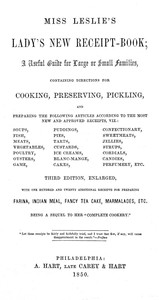
LADY’S NEW RECEIPT-BOOK;
A Useful Guide for Large or Small Families,
CONTAINING DIRECTIONS FOR
COOKING, PRESERVING, PICKLING,
PREPARING THE FOLLOWING ARTICLES ACCORDING TO THE MOST NEW AND APPROVED RECEIPTS, VIZ.:
SOUPS, FISH, MEATS, VEGETABLES, POULTRY, OYSTERS, GAME, PUDDINGS, PIES, TARTS, CUSTARDS, ICE CREAMS, BLANC-MANGE, CAKES, CONFECTIONARY, SWEETMEATS, JELLIES, SYRUPS, CORDIALS, CANDIES, PERFUMERY, ETC.
THIRD EDITION, ENLARGED,
WITH ONE HUNDRED AND TWENTY ADDITIONAL RECEIPTS FOR PREPARING FARINA, INDIAN MEAL, FANCY TEA CAKE, MARMALADES, ETC. BEING A SEQUEL TO HER “COMPLETE COOKERY.”
“Let these receipts be fairly and faithfully tried, and I trust that few, if any, will cause disappointment in the result.”--_Preface_
PHILADELPHIA: A. HART, LATE CAREY & HART 1850.
ENTERED according to Act of Congress, in the year 1850, by A. HART, in the Clerk’s Office of the District Court for the Eastern District of Pennsylvania.
Printed by T. K. & P. G. Collins.
The present volume is designed as a sequel to my book, entitled “Directions for Cookery in all its Branches.” Since the first appearance of that work, I have introduced into the new editions so many improvements and additional receipts that its size can no longer be conveniently increased. While obtaining fresh accessions of valuable knowledge on this and other subjects connected with the domestic improvement of my young countrywomen, I have been induced to note down, as they presented themselves, these new items of information. And I now offer them, arranged in due form, to that most efficient of all patrons, the public.
Families who possess the means and the inclination to keep an excellent table, and to entertain their guests in a handsome and liberal manner, will, most probably, find in this book and its predecessor all that may be wanted for such purposes. A large number of these new receipts are of French origin; obtained from French cooks, or from persons instructed by them. And I have endeavoured to render the directions as intelligible and practicable as possible; so as to be easily understood, and easily followed. I have not thought it necessary to give their titles in French, as foreign designations can rarely be comprehended, or indeed accurately pronounced, except by those who are familiar with the language. Let these and the other receipts be fairly and faithfully tried, and I trust that few, if any, will cause disappointment in the result.
_Philadelphia, Oct. 15th, 1846._
SOUPS, &C. 9 FISH, &C. 19 VEGETABLES, &C. 38 MEATS, &C. 58 POULTRY, GAME, &C. 88 PUDDINGS, &C. 107 SWEETMEATS, &C. 165 BREAKFAST AND TEA CAKES 186 CAKES, &C. 193 DOMESTIC LIQUORS, &C. 230 PERFUMERY, REMEDIES, &C. 252 LAUNDRY-WORK, NEEDLE-WORK, &C. 297 BREAKFASTS, DINNERS, SUPPERS, &C. 365 ADDITIONAL RECEIPTS 395 THE INDIAN MEAL BOOK 455 INDEX 495 INDEX TO ADDITIONAL RECEIPTS 503
Wheat flour one pound of 16 ounces is one quart. Indian meal one pound 2 ounces is one quart. Butter, when soft, one pound 1 ounce is one quart. Loaf-sugar, broken up, one pound is one quart. White sugar, powdered, one pound 1 ounce is one quart. Best brown sugar one pound 2 ounces is one quart. Eggs ten eggs weigh one pound.
Four large table-spoonfuls are half a jill. Eight large table-spoonfuls are one jill. Two jills are half a pint. A common-sized tumbler holds half a pint. A common-sized wine-glass holds about half a jill. Two pints are one quart. Four quarts are one gallon.
About twenty-five drops of any thin liquid will fill a common-sized tea-spoon.
Four table-spoonfuls will generally fill a common-sized wine-glass.
Four wine-glasses will fill a half-pint tumbler, or a large coffee-cup.
A quart black bottle holds in reality about a pint and a half; sometimes not so much.
A table-spoonful of salt is about one ounce.
Half a gallon is a quarter of a peck. One gallon is half a peck. Two gallons are one peck. Four gallons are half a bushel. Eight gallons are one bushel.
Throughout this book, the pound is avoirdupois weight--sixteen ounces.
THE LADY’S RECEIPT-BOOK.
Eliza Leslie's 1850 volume presents itself as a sequel to her earlier Directions for Cookery in all its Branches, but it is far from a mere appendix. The book's subtitle promises guidance for both large and small families, and its contents range from soups and fish to perfumery and ink-making. Leslie explicitly states that many receipts are of French origin, obtained from French cooks or their pupils, yet she deliberately omits French titles, arguing that foreign designations are rarely understood or accurately pronounced by most readers. This editorial choice reveals a tension between cosmopolitan culinary ambition and practical domestic instruction.
French Sources, American Adaptations
Leslie acknowledges that a large number of the new receipts are of French origin, obtained from French cooks or persons instructed by them. However, she does not give their titles in French, asserting that foreign designations can rarely be comprehended or accurately pronounced except by those familiar with the language. This decision reflects a deliberate effort to make French techniques accessible to American housewives without the barrier of foreign terminology. The receipts themselves are rendered in plain English, with step-by-step directions that emphasize clarity and reproducibility. Leslie's approach suggests a confidence that the methods themselves, stripped of exotic labels, would prove valuable to her readers.
Household Chemistry Beyond the Kitchen
The book extends beyond cooking to include detailed instructions for making durable ink, sumach ink, and very fine ink, as well as softening sponges. The ink recipes are remarkably precise, specifying exact weights of Aleppo galls, copperas, gum-arabic, and even sugar-candy, with instructions for steeping, stirring, and bottling. Leslie warns against washing marked articles too soon, noting that soap and water will disturb the ink before it is thoroughly dried. She also advises setting the marking liquid in the sun before use to increase its blackness. These household formulas reveal a world where domestic management required a working knowledge of chemistry and patience for multi-week processes.
Precision and Patience in Every Receipt
Throughout the excerpts, Leslie emphasizes the importance of following directions exactly. In the preface, she writes, "Let these receipts be fairly and faithfully tried, and I trust that few, if any, will cause disappointment in the result." This confidence is backed by meticulous instructions: for very fine ink, the mixture must stand in moderate heat for a fortnight, stirred twice a day, then left undisturbed before bottling. Similarly, the ink-making process requires specific timing and materials, such as dark, heavy Aleppo galls free from holes. Leslie's tone is authoritative but encouraging, assuming her readers are capable of careful execution. The inclusion of such detailed household recipes alongside culinary ones suggests a comprehensive vision of domestic competence.
Readers approaching this book should expect a hybrid work: part cookbook, part household manual, and part chemistry primer. Leslie's voice is practical and direct, assuming a reader who is willing to invest time in multi-day processes. The absence of French titles and the emphasis on clear, step-by-step instructions make the receipts accessible, but the level of detail demands patience. For those interested in mid-19th-century domestic life, this volume offers a window into the skills and knowledge expected of a capable housewife.
That rainy afternoon, Miss Leslie’s ink recipe sent me hunting for a lost letter, and instead I found her bread pudding notes—so calm, so exact. Her practicality made cooking feel like a quiet conversation. Later, my hand drifted toward The A B C of Cooking — Story, Setting & Ideas, and the same unhurried voice met me there, familiar as old linen.

There are no reviews for this eBook.
What did you think of this book?
Answer a few questions and save a private reflection on this device.