About 134 minutes
A little cook book for a little girl — Inside the Classic
Recipes
30,598 recorded words. 5 minutes difference from this book's estimate.
View Gutenberg source #16514
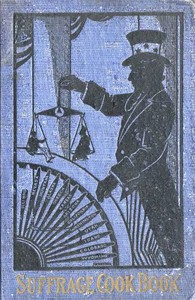
Before opening The Suffrage Cook Book — Reading Notes, the edition data offers a quick orientation: 31,787 words, 2 hr 19 min estimated reading time, and 7 detected text sections.
The text analysis averages about 16.9 words per sentence, while the detected sections provide another way to judge how the source is divided.
Project Gutenberg metadata also associates the work with “Women -- Suffrage -- United States,” connecting these edition facts with the source record’s subject description.
Explore this collection
These alternatives are selected using recorded categories and estimated reading time.
About 134 minutes
Recipes
30,598 recorded words. 5 minutes difference from this book's estimate.
View Gutenberg source #16514About 123 minutes
Recipes
28,078 recorded words. 16 minutes difference from this book's estimate.
View Gutenberg source #25631About 118 minutes
Recipes
27,078 recorded words. 21 minutes difference from this book's estimate.
View Gutenberg source #27639Search stored excerpts and compare books → Choose by your preferences →
Choices use stored catalog measurements. Estimates vary with reading speed. A shared category is a catalog label, not a claim that two books have the same argument or literary quality.
Search reads excerpt text stored with this catalog and links to its associated Gutenberg record. The connection is stored in the site database; this tool does not recheck that every excerpt is word-for-word identical to that external record. Excerpt search does not cover every chapter and does not verify historical publication dates.
Catalog snapshot checked: 2026-09-26. Coverage: 91 public books, 91 available source excerpts.
Calculated from edition completeness, EPUB availability, text structure and catalogue metadata. Not a user rating.
Total of 100 points, scaled to a 2.5-5.0 range. Editions with an empty description or a missing EPUB file are not scored.
Public-domain source text
The source text is kept in the dedicated reader, separate from this catalogue record and its commentary.
The Suffrage Cook Book, compiled by Mrs. L. O. Kleber for the Equal Franchise Federation of Western Pennsylvania in 1915, presents itself as both a practical kitchen manual and a political document. Its introduction frames cooking as a science that women, newly empowered, should direct for the race's welfare. The book's dual purpose is evident: recipes for doughnuts and Devil's Food sit alongside dedications to Mrs. Henry Villard and Mrs. J. O. Miller, and a quote from Judge Ben Lindsey praising women voters for attacking 'the Beast' of corruption. The catalog subjects—Women—Suffrage—United States and Cooking, American—accurately capture this blend, but the excerpts reveal a more layered work where culinary instruction and suffrage advocacy are interwoven, not merely juxtaposed.
The cookbook's recipes are not neutral; they are embedded in a fundraising and advocacy context. The title page credits the Equal Franchise Federation, and the dedication to prominent suffragists signals that every cake or doughnut recipe contributed to the cause. The introduction explicitly connects women's domestic expertise to their political role: 'Now that women are coming into their own, and being sincerely interested in the welfare of the race, it is entirely proper that they should prescribe the food.' This framing turns each recipe into a small act of political participation. The inclusion of a handwritten note in the digital edition further personalizes the collection, reminding readers that these were contributed by real women, likely Federation members, whose names and kitchens were part of the suffrage network.
The introduction critiques earlier cookbooks for mixing recipes with remedies and superstitions, noting that 'professors of the culinary art tell us the cooking has been reduced to a science.' This scientific rhetoric aligns with the suffrage movement's argument that women's rational management of the home qualified them for the vote. The recipes themselves reflect this: they specify precise measurements (e.g., '1 cup Sugar,' '2 Eggs'), leavening agents (baking powder, soda, cream of tartar), and techniques like creaming butter and sugar. Yet the book also includes practical tips, such as adding 'a slice of raw potato in the lard' to prevent a greasy taste in doughnuts—a nod to traditional kitchen wisdom. This blend of science and experience mirrors the movement's strategy of grounding political claims in everyday competence.
Though the excerpts do not list all contributors, the recipes themselves suggest a range of hands. The 'Bride's Cake' uses 12 egg whites, indicating a large-occasion recipe, while 'One Egg Cake' is more modest. 'Pfeffernusse (Pepper Nuts)' includes coriander seed and citron, reflecting ethnic or regional traditions. The inclusion of both 'Lace Cakes' variants—one with walnuts, one with rolled oats—shows variation in ingredient availability. This diversity implies that the cookbook gathered contributions from women across economic and cultural backgrounds, united by the suffrage cause. The dedication to two women, Mrs. Henry Villard and Mrs. J. O. Miller, likely prominent local suffragists, anchors the collection in a specific organizational effort, but the recipes themselves speak to a broader community of cooks.
Readers approaching The Suffrage Cook Book should treat it as a historical artifact that uses the familiar format of a recipe collection to advance a political agenda. The excerpts show that the book's value lies not only in its recipes—many of which are standard early 20th-century American fare—but in how it frames domestic work as a foundation for civic participation. Pay attention to the introductory essay, the dedications, and the occasional political quote; these elements transform a cookbook into a suffrage document. The recipes themselves, while usable, are best understood as contributions to a collective effort, each one a small brick in the building of a movement.
I keep thinking about my grandmother’s shelf, where a stained cookbook sat beside a field guide to fungi. Both felt like survival manuals for a kind of faith—that feeding people could change their minds. Flipping through Toadstools, mushrooms, fungi, edible and poisonous; one thousand American fungi How to select and cook the edible; how to distinguish and avoid the poisonous, with full — Edition Insights later, I recognized that same quiet confidence: knowing exactly what nourishes, and what to leave alone.
Build a private reading journal entry for this title.