About 113 minutes
Paper-bag Cookery — Key Ideas to Explore
Historical Cookbooks
25,841 recorded words. 1 minutes difference from this book's estimate.
View Gutenberg source #41406
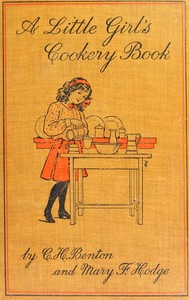
A little girl's cookery book — Reading Companion can be approached with a clearer sense of reading commitment from its source measurements: 26,145 words, 1 hr 54 min estimated reading time, and 11 detected text sections.
The text analysis averages about 16.8 words per sentence, while the detected sections provide another way to judge how the source is divided.
Project Gutenberg metadata also associates the work with “Cooking -- Juvenile literature,” connecting these edition facts with the source record’s subject description.
Explore this collection
These alternatives are selected using recorded categories and estimated reading time.
About 113 minutes
Historical Cookbooks
25,841 recorded words. 1 minutes difference from this book's estimate.
View Gutenberg source #41406About 131 minutes
Historical Cookbooks
30,059 recorded words. 17 minutes difference from this book's estimate.
View Gutenberg source #49155About 134 minutes
Historical Cookbooks
30,621 recorded words. 20 minutes difference from this book's estimate.
View Gutenberg source #13669Search stored excerpts and compare books → Choose by your preferences →
Choices use stored catalog measurements. Estimates vary with reading speed. A shared category is a catalog label, not a claim that two books have the same argument or literary quality.
Search reads excerpt text stored with this catalog and links to its associated Gutenberg record. The connection is stored in the site database; this tool does not recheck that every excerpt is word-for-word identical to that external record. Excerpt search does not cover every chapter and does not verify historical publication dates.
Catalog snapshot checked: 2026-09-26. Coverage: 91 public books, 91 available source excerpts.
Calculated from edition completeness, EPUB availability, text structure and catalogue metadata. Not a user rating.
Total of 100 points, scaled to a 2.5-5.0 range. Editions with an empty description or a missing EPUB file are not scored.
Public-domain source text
The source text is kept in the dedicated reader, separate from this catalogue record and its commentary.
A Little Girl's Cookery Book (1911) by Caroline French Benton and Mary Florence Hodge is structured as a practical guide framed by the story of a child named Margaret who wants to cook. The book is divided into three parts—Breakfast Dishes, Luncheon or Supper Dishes, and Dinner and Tea Dishes, Sauces and Sweets—each building on the previous. The authors adopt a direct, instructional voice, often addressing the reader as “you” and including specific measurements and techniques, such as “three shakes of pepper” or “butter the size of a walnut.” The narrative frame appears only in the introduction and occasional asides, such as when Margaret’s mother shares a recipe learned in Paris. This blend of story and instruction gives the work a distinctive character among early twentieth-century juvenile cookbooks.
The book opens with a fairy-tale line—“Once upon a time there was a little girl named Margaret”—but quickly shifts into a practical cooking manual. The narrative frame is used sparingly: Margaret appears in the introduction and resurfaces in a few recipe headnotes, such as when her mother contributes a macaroni recipe “got … in Paris.” This framing device serves to personalize the instructions without overwhelming the recipes. The authors maintain a consistent second-person address (“you”) throughout the recipe steps, creating a sense of direct guidance. The result is a hybrid text that moves between storytelling and instruction, a structure that would have appealed to young readers learning to cook at home.
Across the excerpts, certain phrases and images recur, emphasizing careful measurement and observation. The instruction to use “three shakes of pepper” appears in multiple recipes, suggesting a standardized seasoning method. The phrase “butter the size of a walnut” is another repeated image, offering a visual, non-standard unit of measure. Vegetables are described with attention to their state: peas are done when they “have little dents in their sides,” and carrots must be “stewed until very soft.” These recurring details create a consistent sensory language—touch, sight, and taste—that guides the young cook through each step. The authors also stress timing, from “fifteen minutes, if they are fresh from the garden” to “half an hour or more” for older peas, acknowledging variable ingredients.
The book’s three-part structure mirrors the progression of a day’s meals, from breakfast to dinner. Within each section, recipes are grouped by course or ingredient, but the authors also move between techniques: boiling, stewing, frying, baking, and making sauces. For example, the vegetable recipes in Part II include both boiled and stewed preparations, while the macaroni dish requires layering and baking. The salad section mentions both French dressing and mayonnaise, with a note that mayonnaise “seemed too heavy for dinner.” This movement between methods and meals gives the book a pedagogical arc, as the young cook learns increasingly complex skills. The authors occasionally cross-reference recipes, such as when they refer to “white sauce” used in multiple dishes, reinforcing a cumulative learning experience.
Although the book is addressed to a child, the presence of an adult helper is implied throughout. The introduction suggests that Margaret “wanted to cook” and presumably had an adult nearby. In the recipes, steps such as “put some bacon dripping into an iron frying-pan” or “fry in deep fat till brown” would require adult supervision for a young girl in 1911. The authors occasionally include notes that seem directed at the adult, such as the detailed instructions for cleaning asparagus or the caution to “draw the pan to a hotter part of the stove.” The macaroni recipe’s aside about Margaret’s mother further underscores the collaborative nature of the cooking process. This implicit partnership between child and adult is a structural feature of the book, shaping both its tone and its practical use.
Readers approaching A Little Girl's Cookery Book should pay attention to the interplay between the narrative frame and the recipe instructions. The book rewards a sequential reading, as techniques introduced early reappear in later dishes. The authors’ use of recurring phrases and visual measurements creates a consistent, memorable language that helps build confidence in the kitchen. While the book is clearly intended for a young audience, its precise methods and occasional adult asides make it a document of early twentieth-century domestic education.
Reading about Margaret's careful measurements, I remembered my own first kitchen attempts, a clumsy rhubarb pie. Cookbooks then felt like quiet companions, not just instructions. That same patient, reassuring spirit lingers in 30 Tempting Spaghetti Meals: Easy, Economical, Delicious — Key Ideas to Explore, a kind of warmth in the promise of something simple made well.
Capture what you thought, learned, and would like to remember.