About 43 minutes
133 Quicker Ways to Homemade, with Bisquick — Text and Context
Recipes
9,710 recorded words. 2 minutes difference from this book's estimate.
View Gutenberg source #61487
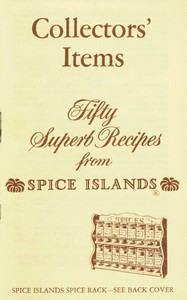
The catalog record for Collectors' Items: Fifty Superb Recipes from Spice Islands — Reading Companion provides practical reading context through 10,170 words, 45 min estimated reading time, and 3 detected text sections.
The text analysis averages about 19.1 words per sentence, while the detected sections provide another way to judge how the source is divided.
Project Gutenberg metadata also associates the work with “Cooking,” connecting these edition facts with the source record’s subject description.
Explore this collection
These alternatives are selected using recorded categories and estimated reading time.
About 43 minutes
Recipes
9,710 recorded words. 2 minutes difference from this book's estimate.
View Gutenberg source #61487About 47 minutes
Recipes
10,585 recorded words. 2 minutes difference from this book's estimate.
View Gutenberg source #65379About 38 minutes
Recipes
8,672 recorded words. 7 minutes difference from this book's estimate.
View Gutenberg source #24542Search stored excerpts and compare books → Choose by your preferences →
Choices use stored catalog measurements. Estimates vary with reading speed. A shared category is a catalog label, not a claim that two books have the same argument or literary quality.
Search reads excerpt text stored with this catalog and links to its associated Gutenberg record. The connection is stored in the site database; this tool does not recheck that every excerpt is word-for-word identical to that external record. Excerpt search does not cover every chapter and does not verify historical publication dates.
Catalog snapshot checked: 2026-09-26. Coverage: 91 public books, 91 available source excerpts.
Calculated from edition completeness, EPUB availability, text structure and catalogue metadata. Not a user rating.
Total of 100 points, scaled to a 2.5-5.0 range. Editions with an empty description or a missing EPUB file are not scored.
Public-domain source text
The source text is kept in the dedicated reader, separate from this catalogue record and its commentary.
This 1959 booklet from the Spice Islands Company presents fifty recipes designed to showcase the company's line of spices, herbs, and seasonings. The opening pages establish a dual identity: part brand catalog, part cooking guide. The company emphasizes quality control—its herbs are California-grown on company farms, its spices sourced from specific regions such as Viet Nam for cinnamon and the Isles of Banda for nutmeg. The recipes themselves are presented as tested and reliable, with an explicit philosophy that seasoning should “enhance, not dominate” the flavor of food. The booklet also includes an herb chart for improvisation, though it is not reproduced in the excerpts.
The booklet opens with a detailed explanation of Spice Islands’ sourcing and production methods. Herbs are “California grown on farms owned and operated by Spice Islands Company,” allowing control over select strains. Spices come from specific origins: cinnamon from Viet Nam, nutmeg from the Isles of Banda, ginger from Jamaica, and pepper from Java. Wine vinegars are produced from Sonoma Valley wines, and teas are gathered from Japan, Formosa, Indonesia, Ceylon, and India. This emphasis on provenance serves to differentiate the brand in a mid-century market increasingly focused on convenience foods. The company also markets a “Spice Rack” (referenced on the back cover) and a line of proprietary seasoning blends such as Beau Monde and Mei Yen, which appear repeatedly in the recipes.
The recipes follow a consistent format: ingredient list with specific brand-name seasonings, followed by step-by-step instructions. Measurements are often precise, including fractions like ¹/₃₂ teaspoon for saffron. The booklet includes both simple preparations, such as “Dill ’n’ Onion Dip” (mayonnaise, sour cream, and four Spice Islands seasonings), and more involved dishes like “Veal Steak with Saffron,” which requires browning meat, coating with a spice blend, and finishing with a milk-and-arrowroot sauce. The instructions for poultry stuffing are notably terse: “Add no liquid or dressing will be soggy.” This directness suggests the intended audience is home cooks comfortable with basic techniques but seeking guidance on seasoning.
Despite the brand’s name evoking tropical origins, the recipes draw from multiple culinary traditions. “Creole Shrimp Gumbo” includes filé powder and chili pequins, while “Poulet Bercy” uses white wine and tarragon in a French-influenced preparation. “Old Hickory Fish Chowder” is described as having a “robust smoky flavor” without meat, relying on seasonings for depth. The booklet also includes an herb chart (mentioned but not excerpted) intended to help cooks improvise. The range suggests Spice Islands positioned its products as versatile enough for everyday meals and special occasions alike, from dips to main courses. The recipes reflect mid-century American tastes—creamy sauces, casseroles, and marinated meats—while introducing exotic ingredients like saffron and gumbo filé.
The booklet’s recipes are best approached as period documents that reveal mid-century American attitudes toward cooking and branding. Readers interested in culinary history will find the explicit sourcing claims and proprietary seasoning blends noteworthy. The herb chart, though not included in the excerpts, likely offers a systematic approach to substitution and experimentation. For contemporary cooks, the recipes may require adjustments in technique or ingredient availability, but they provide a clear window into the home kitchen of 1959.
I keep returning to the Spice Islands booklet, with its patient little herb chart, and I think of the other, older one beside it. Both speak of a kitchen where care was a quiet ritual. That 1945 electric cooking guide has the same unhurried confidence, the same faith in a well-measured knob or pinch. Their kinship is a kind of gentleness. What Every Housewife Should Know About Electric Cooking (1945) — Reading Companion hums beside the spices, a steady rhythm.
Use these questions to collect your thoughts before moving on.