About 38 minutes
Fifty salads — Context and Discussion
Recipes
8,672 recorded words. 1 minutes difference from this book's estimate.
View Gutenberg source #24542
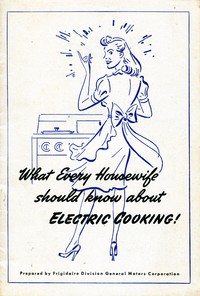
The catalog record for What Every Housewife Should Know About Electric Cooking (1945) — Reading Companion provides practical reading context through 8,383 words, 37 min estimated reading time, and 2 detected text sections.
The text analysis averages about 17.2 words per sentence, while the detected sections provide another way to judge how the source is divided.
Project Gutenberg metadata also associates the work with “Stoves, Electric,” connecting these edition facts with the source record’s subject description.
Explore this collection
These alternatives are selected using recorded categories and estimated reading time.
About 38 minutes
Recipes
8,672 recorded words. 1 minutes difference from this book's estimate.
View Gutenberg source #24542About 35 minutes
Recipes
7,902 recorded words. 2 minutes difference from this book's estimate.
View Gutenberg source #75442About 33 minutes
Recipes
7,539 recorded words. 4 minutes difference from this book's estimate.
View Gutenberg source #67651Search stored excerpts and compare books → Choose by your preferences →
Choices use stored catalog measurements. Estimates vary with reading speed. A shared category is a catalog label, not a claim that two books have the same argument or literary quality.
Search reads excerpt text stored with this catalog and links to its associated Gutenberg record. The connection is stored in the site database; this tool does not recheck that every excerpt is word-for-word identical to that external record. Excerpt search does not cover every chapter and does not verify historical publication dates.
Catalog snapshot checked: 2026-09-26. Coverage: 91 public books, 91 available source excerpts.
Calculated from edition completeness, EPUB availability, text structure and catalogue metadata. Not a user rating.
Total of 100 points, scaled to a 2.5-5.0 range. Editions with an empty description or a missing EPUB file are not scored.
Public-domain source text
The source text is kept in the dedicated reader, separate from this catalogue record and its commentary.
This 1945 booklet from Frigidaire Division of General Motors presents itself not as a conventional cookbook but as a question-and-answer manual: sixty-nine of "the most frequently asked questions (and their answers) about cooking with an Electric Range." The opening pages immediately address the housewife's anxieties—whether she must learn to cook all over again, whether electric cooking is expensive, and how much it costs to preheat a large oven. The tone is reassuring, practical, and promotional, blending technical data with domestic advice.
The booklet's organizing principle—sixty-nine questions and answers—is itself a rhetorical strategy. By posing concerns such as "Do I Have to Learn to Cook All Over Again?" or "Is Cooking by Electricity Expensive?", the text anticipates and neutralizes resistance to a new technology. The answers are concise and confident, often redirecting attention to benefits: "greater simplicity and accuracy, and add greater joy to cooking because it is cleaner, cooler and automatic." This format transforms potential objections into opportunities for reassurance, making the booklet as much a piece of marketing as a practical guide.
The cost table, for instance, provides monthly operating costs based on family size and local electricity rates, from 1¢ to 3¢ per kilowatt-hour. A family of four at the average rate of 2¼¢ would pay $1.89 per month—a figure presented as reasonable and predictable. The answer to question 4 calculates preheating cost at "approximately 1¼c," emphasizing that "much of this heat is conserved during baking or roasting by the oven insulation." Such details ground the promotional claims in specific numbers, lending an air of scientific authority.
The bulk of the booklet consists of reference charts: a Vegetable Cooking Guide, a Baking Times and Temperatures chart, and a Meat and Fowl Roasting Chart. These tables are the work's practical heart, offering precise timings and temperatures for dozens of items. The Vegetable Cooking Guide, for example, lists preparation methods alongside cooking times broken into "Minutes on High for Steaming" and "Minutes on Low or Simmer Until Tender," with a total column. Apples are peeled and quartered, then cooked 3 to 5 minutes on high; green beans may be "cut in slivers, lengthwise" or "broken," each with different timings.
The Baking chart covers breads, rolls, biscuits, pies, muffins, cakes, cookies, and entrees like soufflés and baked beans. Temperatures range from 300°F for baked beans (3 hours) to 450°F for pie shells (15 minutes). The Roasting Chart for meats and fowl specifies both oven temperature and internal temperature targets—rare beef at 140°F, medium at 160°F—along with minutes per pound. These charts assume a reader who already knows basic cooking terms but needs precise, appliance-specific guidance.
Near the beginning, the booklet signals a forward-looking interest: "This probably will answer more questions which have come up in your mind and these answers will be even more important in the future when Home Freezers are as common as Refrigerators and Electric Ranges." This prediction situates the electric range within a broader technological ecosystem, where frozen foods would become a staple. The table of contents lists separate guides for frozen vegetables and frozen meat, indicating that the booklet treats frozen food as a distinct category requiring its own methods.
Though the excerpts do not include those specific frozen food charts, the repeated emphasis on frozen preparation suggests that the booklet is not merely a manual for current practice but also a preparation for an anticipated shift in domestic food storage and cooking. The phrase "keep this booklet handy" implies that the information will remain relevant as kitchens evolve. This temporal awareness—addressing both present questions and future needs—distinguishes the work from a simple recipe collection.
Readers should approach this booklet as a period document that reveals mid-century attitudes toward technology, domestic labor, and consumer education. The question-and-answer format, the detailed charts, and the forward-looking mention of home freezers all reflect a moment when electric cooking was still establishing itself. The text is best used as a reference for specific cooking times and temperatures, but also as a primary source for understanding how manufacturers sought to build trust and competence in a new generation of kitchen appliances.
Sometimes I think of that brisk Frigidaire booklet, with its tidy charts and assurance that frozen peas could be a marvel. It holds a quiet kinship with Culture and Cooking; Or, Art in the Kitchen — Reading Companion, whose older, leisured prose whispers that a good stove is merely a stage for a patient hand. Both share a secret: that method, kindly followed, becomes its own gentle comfort.
Create a short personal record of your experience with this book.