About 173 minutes
Substitutes for Flesh Foods: Vegetarian Cook Book — Background and Themes
Recipes
39,752 recorded words. 2 minutes difference from this book's estimate.
View Gutenberg source #43879
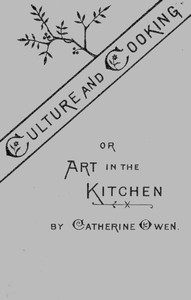
Culture and Cooking; Or, Art in the Kitchen — Reading Companion can be approached with a clearer sense of reading commitment from its source measurements: 40,219 words, 2 hr 55 min estimated reading time, and 5 detected text sections.
The text analysis averages about 33.2 words per sentence, while the detected sections provide another way to judge how the source is divided.
Project Gutenberg metadata also associates the work with “Cooking, American,” connecting these edition facts with the source record’s subject description.
Explore this collection
These alternatives are selected using recorded categories and estimated reading time.
About 173 minutes
Recipes
39,752 recorded words. 2 minutes difference from this book's estimate.
View Gutenberg source #43879About 168 minutes
Recipes
38,618 recorded words. 7 minutes difference from this book's estimate.
View Gutenberg source #1084About 189 minutes
Recipes
43,432 recorded words. 14 minutes difference from this book's estimate.
View Gutenberg source #9464Search stored excerpts and compare books → Choose by your preferences →
Choices use stored catalog measurements. Estimates vary with reading speed. A shared category is a catalog label, not a claim that two books have the same argument or literary quality.
Search reads excerpt text stored with this catalog and links to its associated Gutenberg record. The connection is stored in the site database; this tool does not recheck that every excerpt is word-for-word identical to that external record. Excerpt search does not cover every chapter and does not verify historical publication dates.
Catalog snapshot checked: 2026-09-26. Coverage: 91 public books, 91 available source excerpts.
Calculated from edition completeness, EPUB availability, text structure and catalogue metadata. Not a user rating.
Total of 100 points, scaled to a 2.5-5.0 range. Editions with an empty description or a missing EPUB file are not scored.
Public-domain source text
The source text is kept in the dedicated reader, separate from this catalogue record and its commentary.
Catherine Owen opens her 1881 book with a disclaimer: "This is not a cookery book." Instead, she positions it as a bridge between the cook and her household oracle, aiming to explain why recipes fail. The preface cites Brillat-Savarin and mentions Charlotte Brontë and Margaret Fuller to argue that cooking and cultivation are not antagonistic. Owen's voice is direct and personal, addressing the reader as "you" and drawing on shared frustrations—such as pale, sodden roast meat or bread with a hard crust. She promises not a collection of recipes but a guide to understanding the principles behind them.
Owen's narrative voice is that of an experienced friend, not a distant expert. She uses rhetorical questions ("Who does not remember...?") and direct address ("Perhaps the cook will tell you...") to create intimacy. Her tone is occasionally wry: she describes the "exasperating old friends" whose vague recipes maddened our mothers. This personal approach extends to her own authority—she admits to introducing French chef recipes but frames them as "good things little known." The voice is confident but not condescending, and she often anticipates the reader's confusion, as when she explains why pepper should be added after cooking: "the flavor of pepper is entirely changed by the parching it undergoes."
The book's structure moves from general principles to specific techniques. The preface establishes the philosophy; then chapters on bread, pastry, and store-room supplies follow. Each section begins with common failures ("Why you fail in making good puff paste") before offering solutions. Owen's explanations are methodical: for roasting, she details the oven temperature, the pan setup, the timing of turning, and the gravy-making process. She warns against common errors, such as putting meat in a cool oven or adding water to a fat pan. This step-by-step approach, grounded in cause and effect, makes the book a practical manual rather than a mere collection of recipes.
Owen varies her pacing between brisk instructions and reflective asides. In the roasting section, she moves quickly through the steps—"Heat up the oven till it is quite brisk, then put the meat in a pan"—but pauses to explain the science: the surface should be covered with "osma-zone," a glaze that seals in juices. She also digresses into sensory details, such as the "offensive" odor of scorched pepper. These shifts keep the prose from becoming monotonous. The later chapters, which include recipes for mushroom powder and glaze, are more terse, suggesting a deliberate change in pace as the book moves from teaching principles to providing reference material.
Readers will find Owen's approach most useful when they read sequentially, as she builds on earlier concepts. The book rewards attention to her explanations of why methods work, not just how to execute them. Her insistence on precise timing and temperature—and her warnings against common pitfalls—make this a valuable companion to any standard cookbook of the period. For those interested in the history of American domestic advice, Owen's voice offers a rare blend of literary reference and practical kitchen wisdom.
It’s odd how books find us—I came to Catherine Owen’s careful talk of failing bread and wish I’d had her patience then. But her quiet insistence that cooking is just attention lingers, like something remembered. That same thoughtful pace seems to wait inside Chinese recipes — Story, Setting & Ideas, which I keep near my own kitchen, leafing through when the day feels hurried.
Save your reaction, strongest insight, and memorable passage.