About 27 minutes
Chinese recipes — Story, Setting & Ideas
Recipes
6,036 recorded words. 4 minutes difference from this book's estimate.
View Gutenberg source #76573
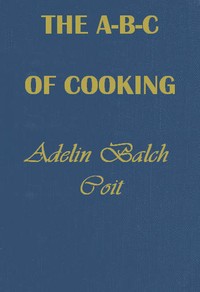
Before opening The A B C of Cooking — Story, Setting & Ideas, the edition data offers a quick orientation: 5,221 words, 23 min estimated reading time, and 1 detected text section.
The text analysis averages about 21.9 words per sentence, while the detected sections provide another way to judge how the source is divided.
Project Gutenberg metadata also associates the work with “Cooking, American,” connecting these edition facts with the source record’s subject description.
Explore this collection
These alternatives are selected using recorded categories and estimated reading time.
About 27 minutes
Recipes
6,036 recorded words. 4 minutes difference from this book's estimate.
View Gutenberg source #76573About 28 minutes
Recipes
6,218 recorded words. 5 minutes difference from this book's estimate.
View Gutenberg source #62230About 17 minutes
Recipes
3,842 recorded words. 6 minutes difference from this book's estimate.
View Gutenberg source #34185Search stored excerpts and compare books → Choose by your preferences →
Choices use stored catalog measurements. Estimates vary with reading speed. A shared category is a catalog label, not a claim that two books have the same argument or literary quality.
Search reads excerpt text stored with this catalog and links to its associated Gutenberg record. The connection is stored in the site database; this tool does not recheck that every excerpt is word-for-word identical to that external record. Excerpt search does not cover every chapter and does not verify historical publication dates.
Catalog snapshot checked: 2026-09-26. Coverage: 91 public books, 91 available source excerpts.
Calculated from edition completeness, EPUB availability, text structure and catalogue metadata. Not a user rating.
Total of 100 points, scaled to a 2.5-5.0 range. Editions with an empty description or a missing EPUB file are not scored.
Public-domain source text
The source text is kept in the dedicated reader, separate from this catalogue record and its commentary.
Adeline Balch Coit's The A B C of Cooking (1917) is a compact manual addressed explicitly to men with no cooking experience, intended for use on small boats, patrol boats, in camps, or on marches. The book's dedication to the Knitting Committee of the American Defense Society situates it within World War I home-front efforts, aiming to make soldiers and sailors more comfortable. The recipes are stripped to essentials: coffee is made by mixing grounds with cold water into a wet paste, then boiling; tea steeps for exactly three minutes; cocoa is heated slowly with milk. Portions are often given for three persons, with a note to increase or decrease ingredients proportionally. The language is direct and assumes minimal equipment—a coffee pot, a saucepan, a fire.
The recipes consistently rely on a short list of shelf-stable or easily procured ingredients: oatmeal, corn meal, hominy, rice, macaroni, canned fish, canned corn, canned tomatoes, and dried fruit. Fresh items appear only in a few vegetable recipes—potatoes, string beans, sweet corn, peas—and even those are boiled simply. The absence of fresh meat beyond bacon and steak is notable; the meat stew and corned beef hash use canned or preserved products. This suggests the book was designed for situations where refrigeration was unavailable and supply chains were limited. The instructions assume the cook has access to boiling water, a fire, and basic utensils, but no oven for baking—biscuits and muffins are made on a griddle or in a pan. The emphasis is on speed and reliability: oatmeal and corn meal both boil for fifteen minutes; rice boils for fifteen minutes after washing. The book's structure mirrors the constraints of field cooking, where every minute and every ingredient counts.
Coit's prose is remarkably spare and procedural, leaving no step to inference. For macaroni, she writes: 'Break into inch pieces a cup full of macaroni, and cover with boiling water in a saucepan. Add a little salt, and cook until soft (about an hour). Keep covered with water while boiling.' The instruction to keep the macaroni covered with water is the kind of detail an experienced cook might omit, but a novice would need. Similarly, for fried eggs and bacon, the recipe likely explains the sequence (though the excerpt cuts off). The book's title—The A B C of Cooking—is literal: it starts from the alphabet of kitchen knowledge. The opening epigraph, 'Unless the kettle boiling be, filling the tea pot spoils the tea,' reinforces the theme that fundamental steps must be mastered first. This pedagogical clarity makes the book a historical document of how cooking was taught to absolute beginners in a military context.
The dedication to the Knitting Committee of the American Defense Society explicitly links the cookbook to the war effort: 'it is hoped that both cook-book and knitted garments may help to make more comfortable the men who are only too ready to do their bit.' This frames cooking as a form of patriotic service, extending domestic labor into the military sphere. The recipes themselves reflect economy—using canned goods, stretching ingredients with water, and avoiding waste. For example, coffee with an egg uses 'shell and all,' a thrifty technique that also clarifies the brew. The book's small size (5,221 words) and portable format suggest it was meant to be carried in a pocket or kit. The 1917 publication date places it just after the U.S. entry into World War I, when such practical guides would have been in demand. Coit's work is a snapshot of how American domestic science adapted to wartime conditions, translating home economics into field rations.
Readers approaching The A B C of Cooking should note that it is not a comprehensive cookbook but a targeted manual for a specific audience and setting. The recipes are best understood as historical artifacts of early twentieth-century foodways and military logistics. The book's value lies in its directness and its reflection of the material realities of its time—limited ingredients, basic equipment, and an urgent need for nourishing meals. For modern cooks, it offers a glimpse into the culinary constraints of the past and the ingenuity required to work within them.
There’s a quiet kinship between that 1917 cookbook for men on small boats—its coffee and flapjacks measured for wartime patience—and Camp fires and camp cooking — A Reader’s Guide. Both understand how a simple meal, made carefully, can steady a tired soul. I’ve always found that tenderness between the two. That’s all.
Your answers remain private and are stored only in this browser.