Mrs. Beeton's Dictionary of Every-Day Cookery The "All About It" Books — Reading Notes
Edition facts
Mrs. Beeton's Dictionary of Every-Day Cookery The "All About It" Books — Reading Notes can be approached with a clearer sense of reading commitment from its source measurements: 266,366 words, 19 hr 19 min estimated reading time, and 40 detected text sections.
The text analysis averages about 16.5 words per sentence, while the detected sections provide another way to judge how the source is divided.
Project Gutenberg metadata also associates the work with “Cooking, English,” connecting these edition facts with the source record’s subject description.
Calculated from edition completeness, EPUB availability, text structure and catalogue metadata. Not a user rating.
How this score is calculated
- Description quality20 pts
- Title & short description10 pts
- Source metadata20 pts
- Text length15 pts
- Chapters / structure15 pts
- EPUB file integrity20 pts
Total of 100 points, scaled to a 2.5-5.0 range. Editions with an empty description or a missing EPUB file are not scored.
Read the Text
[Transcriber's Note: Bold text is surrounded by =equal signs= and italic text is surrounded by _underscores_.]
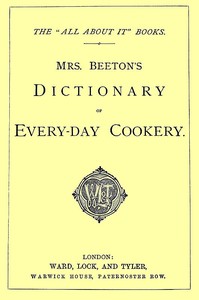
DICTIONARY OF EVERY-DAY COOKERY.
_THE “ALL ABOUT IT” BOOKS_
LONDON: WARD, LOCK, AND TYLER, WARWICK HOUSE, PATERNOSTER ROW.
LONDON: SAVILL, EDWARDS AND CO., PRINTERS. CHANDOS STREET, COVENT GARDEN.
_The reasons for the publication of this Volume—the First of a Series of Practical Manuals which were to be called the “All About It” Books—were thus explained in a Prospectus issued a few months ago, and approved by the late_ Mrs. S. O. BEETON:—
MANY wishes have been expressed to the Authoress of the “Book of Household Management” that a volume of Recipes in Cookery should be written which could be sold at a price somewhere between the seven-and-sixpenny “Household Management” and the Shilling Cookery Book. Accordingly Mrs. BEETON has prepared a Collection of Recipes, and of other Practical Information concerning the Dressing and Serving of Family Fare, which, when completed, will be published, in serviceable binding, at the price of Three Shillings and Sixpence.
As Mistress, Cook, and Critic have declared that the details in Mrs. BEETON’S larger work are _so easy to understand_, the Authoress has followed, in every Recipe printed in the present Dictionary, the same simple plan she originally used. Regarding, however, the _arrangement_ of the Recipes, the Authoress has chosen the Dictionary form, believing an alphabetical arrangement to be the best for a book that is being constantly referred to. By the adoption of a very intelligible system, all _cross_ reference, and that very disagreeable parenthesis (_See_ So-and-so) is avoided, except in a very few instances. Where any warning as to what should _not_ be done is likely to be needed, it is given, as well as advice as to what ought to be done. No pains have been thought too great to make _little things_ clearly understood. Trifles constitute perfection. It is just the knowledge or ignorance of little things that usually makes the difference between the success of the careful and experienced housewife or servant, and the failure of her who is careless and inexperienced. Mrs. BEETON has brought to her new offering to the Public a most anxious care to describe plainly and fully all the more difficult and recondite portions of Cookery, whilst the smallest items have not been “unconsidered trifles,” but each Recipe and preparation have claimed minute attention.
DICTIONARY OF COOKERY.
_Ingredients._—½ lb. of sweet almonds, 1 oz. of bitter almonds, 6 eggs, 8 tablespoonfuls of sifted sugar, 5 tablespoonfuls of fine flour, the grated rind of 1 lemon, 3 oz. of butter. _Mode._—Blanch and pound the almonds to a paste; separate the whites from the yolks of the eggs; beat the latter, and add them to the almonds. Stir in the sugar, flour, and lemon-rind; add the butter, which should be beaten to a cream; and, when all these ingredients are well mixed, put in the whites of the eggs, which should be whisked to a stiff froth. Butter a cake-mould, put in the mixture, and bake in a good oven from 1¼ to 1¾ hour. _Time._—1¼ to 1¾ hour. _Average cost_, 2_s._ 6_d._ _Seasonable_ at any time.
_Ingredients._—¼ lb. of sweet almonds, 4 bitter ones, 3 eggs, 2 oz. of butter, the rind of ¼ lemon, 1 tablespoonful of lemon-juice, 3 oz. of sugar. _Mode._—Blanch and pound the almonds smoothly in a mortar, with a little rose or spring water; stir in the eggs, which should be well beaten, and the butter, which should be warmed; add the grated lemon-peel and juice, sweeten, and stir well until the whole is thoroughly mixed. Line some patty-pans with puff-paste, put in the mixture, and bake for 20 minutes, or rather less, in a quick oven. _Time._—20 minutes, or rather less. _Average cost_, 10_d._ _Sufficient_ for about 12 cheesecakes.
ALMOND PASTE, for Second-Course Dishes.
_Ingredients._—1 lb. of sweet almonds, 6 bitter ones, 1 lb. of very finely-sifted sugar, the whites of 2 eggs. _Mode._—Blanch the almonds, and dry them thoroughly; put them into a mortar, and pound them well, wetting them gradually with the whites of 2 eggs. When well pounded, put them into a small preserving-pan, add the sugar, and place the pan on a small but clear fire (a hot plate is better); keep stirring until the paste is dry, then take it out of the pan, put it between two dishes, and, when cold, make it into any shape that fancy may dictate. _Time._—½ hour. _Average cost_, 2_s._ 8_d._ for the above quantity. _Sufficient_ for 3 small dishes of pastry. _Seasonable_ at any time.
ALMOND PUDDING, Baked (very rich).
Mrs. Beeton's Dictionary of Every-Day Cookery adopts an alphabetical arrangement, a deliberate choice explained in the preface as the best form for a reference book. The author avoids cross-references, except in a few instances, to streamline use. Her method follows the same simple plan as her larger work, with each recipe including ingredients, mode, time, average cost, and seasonable notes. The preface states that 'trifles constitute perfection,' and the excerpts bear this out: instructions for macaroni specify the form should be 'entirely preserved,' and for macaroons, the paste is dropped from a biscuit syringe onto wafer paper. The book is part of the 'All About It' series, priced at three shillings and sixpence.
Alphabetical Structure and Cross-Reference
The dictionary form is central to the work's utility. The preface explains that this arrangement was chosen to avoid 'that very disagreeable parenthesis (See So-and-so).' Cross-references are rare, making each entry self-contained. For example, the entry for 'Mackerel' includes separate sub-entries for baked, boiled, broiled, and fillets, each with its own ingredients and method. This structure allows a cook to find a specific preparation without flipping pages. The alphabetical order also means that unrelated dishes—like 'Almond Cake' and 'Macaroons'—sit side by side, emphasizing the book's role as a quick reference rather than a narrative cookbook.
Precision in Ingredients and Method
Recipes are remarkably detailed. For 'Almond Cake,' the ingredients list includes both sweet and bitter almonds, with exact quantities in pounds and ounces. The method for 'Macaroons' specifies blanching, skinning, and drying almonds, then pounding them with 'a little orange flower or plain water.' The whites of eggs must be 'beaten to a stiff froth.' Such precision reflects the author's 'anxious care to describe plainly and fully.' Even small items receive 'minute attention,' as the preface claims. The entry for 'Mackerel, Broiled' warns that the fish 'should never be washed' when intended for broiling, only wiped clean—a specific detail that could affect texture.
Cost, Seasonality, and Practical Notes
Each recipe includes an average cost and seasonable months, grounding the book in everyday household management. For 'Mackerel, Baked,' the cost for four fish is 1 s. 10 d., and it is seasonable from April to July. The 'Note' section often adds variations: baked mackerel 'may be dressed in the same way as baked herrings, and may also be stewed in wine.' For 'Macaroni,' the time to swell is given as 40 to 50 minutes, and the dish is 'sufficient for 4 or 5 persons.' These practical details help the cook plan meals and budgets, aligning with the book's aim to serve 'the careful and experienced housewife or servant.'
Voice and Authorial Presence
Though the entries are instructional, the author's voice emerges through occasional warnings and preferences. In 'Mackerel, Boiled,' a note suggests that 'caper or anchovy sauce is sometimes served' as a variation. The preface uses first-person plural ('we') in the prospectus, but the recipes themselves are impersonal. However, the choice of words like 'nice delicate forcemeat' for baked mackerel reveals a judgment. The author also addresses the reader directly in the preface: 'No pains have been thought too great to make little things clearly understood.' This blend of authority and care characterizes the work as a guide from an experienced hand, not a mere compilation.
The dictionary format and the inclusion of cost, time, and seasonality make this book a practical tool for the Victorian household. Readers should note that the excerpts represent only a fraction of the 266,366-word text, which covers a wide range of dishes. The alphabetical arrangement invites browsing as much as targeted searching, and the consistent structure across entries rewards careful reading. For those interested in historical cooking methods, the precise instructions offer a window into 19th-century domestic practice.
I keep thinking about how Mrs. Beeton’s calm, alphabetical order made even the smallest kitchen task feel important, like trifles deserved the same care as roasts. There’s something tender in that quiet thoroughness. Paper-bag Cookery — Key Ideas to Explore stirs the same gentle feeling—a simple method, trusted completely, holding its own unspoken grace.

There are no reviews for this eBook.
Record your reading impressions
A brief reflection can help important ideas stay with you longer.