About 1,159 minutes
Mrs. Beeton's Dictionary of Every-Day Cookery The "All About It" Books — Reading Notes
Historical Cookbooks
266,366 recorded words. 145 minutes difference from this book's estimate.
View Gutenberg source #50191
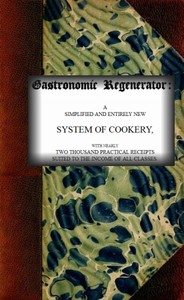
The Gastronomic Regenerator: A Simplified and Entirely New System of Cookery With Nearly Two Thousand Practical Receipts Suited to the Income of All Classes — Edition Insights can be approached with a clearer sense of reading commitment from its source measurements: 299,811 words, 21 hr 44 min estimated reading time, and 29 detected text sections.
The text analysis averages about 34.1 words per sentence, while the detected sections provide another way to judge how the source is divided.
Project Gutenberg metadata also associates the work with “Cooking,” connecting these edition facts with the source record’s subject description.
Explore this collection
These alternatives are selected using recorded categories and estimated reading time.
About 1,159 minutes
Historical Cookbooks
266,366 recorded words. 145 minutes difference from this book's estimate.
View Gutenberg source #50191About 967 minutes
Historical Cookbooks
222,201 recorded words. 337 minutes difference from this book's estimate.
View Gutenberg source #42544About 738 minutes
Historical Cookbooks
169,658 recorded words. 566 minutes difference from this book's estimate.
View Gutenberg source #40943Search stored excerpts and compare books → Choose by your preferences →
Choices use stored catalog measurements. Estimates vary with reading speed. A shared category is a catalog label, not a claim that two books have the same argument or literary quality.
Search reads excerpt text stored with this catalog and links to its associated Gutenberg record. The connection is stored in the site database; this tool does not recheck that every excerpt is word-for-word identical to that external record. Excerpt search does not cover every chapter and does not verify historical publication dates.
Catalog snapshot checked: 2026-09-26. Coverage: 91 public books, 91 available source excerpts.
Calculated from edition completeness, EPUB availability, text structure and catalogue metadata. Not a user rating.
Total of 100 points, scaled to a 2.5-5.0 range. Editions with an empty description or a missing EPUB file are not scored.
Public-domain source text
The source text is kept in the dedicated reader, separate from this catalogue record and its commentary.
Alexis Soyer's The Gastronomic Regenerator (1849) opens with a dedication to the Duke of Cambridge and a list of aristocratic patrons, immediately establishing its dual audience: the wealthy households who could afford elaborate kitchen plans and the broader readership promised recipes "suited to the income of all classes." The title itself—claiming a "simplified and entirely new system"—signals Soyer's ambition to reform cookery through methodical instruction. Yet the excerpts reveal a voice that is anything but simple: Soyer writes with the precision of a technician, detailing bone-in procedures, diamond-shaped cuts, and the exact thickness of aspic layers. His prose moves briskly through complex sequences, assuming a reader who can follow instructions like "dip the pan in warm water and turn it out upon a clean cloth" without further explanation. This tension between accessibility and exacting technique defines the book's character.
Soyer's narrative voice is that of a professional instructing peers, not a teacher simplifying for amateurs. He uses imperative verbs and precise measurements: "cut also some slices of cucumber, which stew in white stock with a little sugar till quite tender." The tone is brisk and confident, rarely pausing to explain basic terms like "aspic" or "quenelle." When he does offer alternatives—such as using English mustard instead of French to keep a sauce white—he does so without condescension. This voice assumes a reader already familiar with kitchen equipment and techniques, which aligns with the book's subtitle promising a system for "all classes" but suggests the intended audience may have been experienced cooks or household managers rather than novices.
The recipes in the excerpts follow a recurring structural logic: ingredients are prepared separately, assembled in layers or molds, then finished with a sauce or garnish. For instance, Salade de Volaille à la Sultane builds a pyramid of fowl pieces over salad, while Moule d’Aspic à la Royale uses a cylindrical mold to create a crown of fillets. Soyer often specifies the shape and size of cuts—"half-crown pieces," "diamond shape"—and the order of chilling, dipping, and unmolding. This systematic approach reflects the "new system" promised in the title, but it also creates a rhythm: each recipe becomes a miniature construction project, with the cook acting as both architect and builder. The repetition of phrases like "dip the mould in warm water and turn it out" reinforces the methodical, almost mechanical nature of the process.
Many of the excerpted recipes are for cold entrées and aspics, which demand a particular pacing: cooking, cooling, setting, and unmolding. Soyer's instructions move quickly through the cooking phase—"stew them an hour or rather more"—then slow down for the assembly and chilling steps. He often uses the phrase "place upon the ice" to mark a pause in the action, followed by a rapid sequence of dipping, cutting, and dressing. This alternation between active cooking and passive setting creates a distinctive tempo. The reader must coordinate timing across multiple components: a sauce must be "about half cold" before the chicken is dipped, while the aspic must be "quite set" before unmolding. Soyer's prose mirrors this rhythm, with short, imperative sentences for actions and longer clauses for conditions, giving the text a pulse that matches the kitchen workflow.
Readers approaching The Gastronomic Regenerator should pay attention to Soyer's use of cross-references—he frequently directs readers to other numbered recipes for sauces, forcemeats, or aspics. This network of references turns the book into a modular system, where individual recipes are components of larger constructions. Rather than reading straight through, consider tracing a single technique—such as aspic-making—across multiple entries to see how Soyer adapts it for different dishes. The book rewards a nonlinear, exploratory reading that mirrors the cook's own process of assembling a meal from its constituent parts.
There’s something tender about Soyer’s careful aspics and layered salads, as if he trusted us to rise to the occasion. Reading him, I often think of the fish chapter, the quiet patience it takes to bone a trout properly. That same unhurried confidence lives in A Handbook of Fish Cookery: How to buy, dress, cook, and eat fish — Background and Themes, a gentler companion for those long, reflective evenings at the stove.
Capture what you thought, learned, and would like to remember.