About 225 minutes
The Golden Age Cook Book — Edition Insights
Home Economics
51,722 recorded words. 8 minutes difference from this book's estimate.
View Gutenberg source #26209
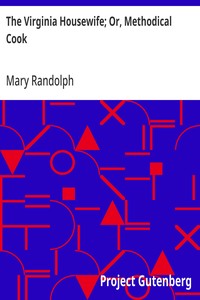
This digital edition of The Virginia Housewife; Or, Methodical Cook — A Reader’s Guide is described by source-level measurements including 49,811 words, 3 hr 37 min estimated reading time, and 6 detected text sections.
The text analysis averages about 38.7 words per sentence, while the detected sections provide another way to judge how the source is divided.
Project Gutenberg metadata also associates the work with “Cooking, American,” connecting these edition facts with the source record’s subject description.
Explore this collection
These alternatives are selected using recorded categories and estimated reading time.
About 225 minutes
Home Economics
51,722 recorded words. 8 minutes difference from this book's estimate.
View Gutenberg source #26209About 202 minutes
Home Economics
46,431 recorded words. 15 minutes difference from this book's estimate.
View Gutenberg source #33213About 191 minutes
Home Economics
43,922 recorded words. 26 minutes difference from this book's estimate.
View Gutenberg source #6703Search stored excerpts and compare books → Choose by your preferences →
Choices use stored catalog measurements. Estimates vary with reading speed. A shared category is a catalog label, not a claim that two books have the same argument or literary quality.
Search reads excerpt text stored with this catalog and links to its associated Gutenberg record. The connection is stored in the site database; this tool does not recheck that every excerpt is word-for-word identical to that external record. Excerpt search does not cover every chapter and does not verify historical publication dates.
Catalog snapshot checked: 2026-09-26. Coverage: 91 public books, 91 available source excerpts.
Calculated from edition completeness, EPUB availability, text structure and catalogue metadata. Not a user rating.
Total of 100 points, scaled to a 2.5-5.0 range. Editions with an empty description or a missing EPUB file are not scored.
Public-domain source text
The source text is kept in the dedicated reader, separate from this catalogue record and its commentary.
Mary Randolph opens The Virginia Housewife with a preface that frames cookery as a system of precise weights and measures, comparing household management to the government of a nation. She insists that a regular system, once matured, should become an inviolable law. The introduction reinforces this by urging early breakfasts and daily inspection of each department to detect errors before they grow. This structural emphasis on method recurs throughout the recipes, which often specify exact proportions and alternative ingredients.
The preface declares that every ingredient should be given in just proportions so the result is always equally good. This principle is visible in recipes like Oyster Catsup, where salt, mace, and cayenne are measured by ounce and drachm per pint of oysters. The method extends to infusions: Celery Vinegar requires two gills of seed shaken daily for a fortnight, while thyme and mint must be steeped no more than twenty hours to avoid bitterness. Randolph treats each recipe as a repeatable experiment, not a vague instruction.
Randolph frequently offers alternatives, revealing a practical awareness of ingredient availability. For caper sauce, she suggests pickled nasturtiums or minced green pickle when capers cannot be obtained. The Oyster Catsup recipe includes an optional glass of brandy to extend shelf life. These substitutions are not afterthoughts but integrated into the method, showing that the system is designed to adapt. The same flexibility appears in the salad dressing, where tarragon vinegar is specified but the base of egg yolks, oil, and mustard remains constant.
Randolph’s instructions for boiling potatoes are remarkably precise: cover them with cold water about an inch deep, simmer slowly, and pour off the water immediately when done. She warns against relying on the skin cracking, which can mislead. This attention to timing extends to the salad, which must be dressed just before serving, and to the herb infusions, where oversteeping extracts a coarse, bitter taste. The introduction’s insistence on early breakfast and orderly meals is mirrored in these micro-timings, creating a layered structure of daily and momentary rhythms.
The recipes often trace a clear path from raw component to finished condiment or sauce. Celery vinegar begins with seed and vinegar, undergoes a fortnight of shaking, then is strained for use. Oyster Catsup moves from fresh oysters through pounding, boiling, sieving, and bottling. Even the salad dressing follows a sequence: boil eggs, cool, separate yolks, dissolve with water, add oil, seasonings, and vinegars. Randolph’s methodical approach ensures that each step is justified, and the final product is predictable. This movement from base to completed item reinforces the book’s core argument that management is an art acquired by good sense and tolerable memory.
Readers will find that Randolph’s system rewards careful attention to her precise measurements and timing. The recipes are best approached as a sequence of steps rather than a list of ingredients; the method is the message. Whether one is a novice or an experienced cook, the book offers a window into early nineteenth-century Virginia domestic economy, where order and adaptability were equally valued.
I have often thought how companionable Mrs. Randolph’s firm measures are beside the relaxed assurances of the New Royal Cook Book. One trusts a precise hand, the other a generous one, yet both whisper the same quiet secret: a kitchen knows its rhythm if we simply listen. There is a warmth in that. New Royal Cook Book — Text and Context sits nearby on my shelf, a calmer fellow traveler.
Create a short personal record of your experience with this book.