About 46 minutes
Fifty soups — Reading Companion
Home Economics
10,547 recorded words. 9 minutes difference from this book's estimate.
View Gutenberg source #25007
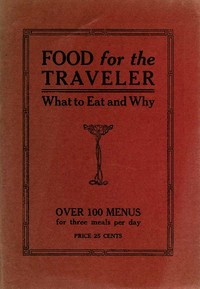
For Food for the traveler — Story, Setting & Ideas, the stored edition analysis reports 8,379 words, 37 min estimated reading time, and 1 detected text section.
The text analysis averages about 15.0 words per sentence, while the detected sections provide another way to judge how the source is divided.
Project Gutenberg metadata also associates the work with “Cooking, American,” connecting these edition facts with the source record’s subject description.
Explore this collection
These alternatives are selected using recorded categories and estimated reading time.
About 46 minutes
Home Economics
10,547 recorded words. 9 minutes difference from this book's estimate.
View Gutenberg source #25007About 49 minutes
Home Economics
11,046 recorded words. 12 minutes difference from this book's estimate.
View Gutenberg source #64687About 50 minutes
Home Economics
11,277 recorded words. 13 minutes difference from this book's estimate.
View Gutenberg source #49833Search stored excerpts and compare books → Choose by your preferences →
Choices use stored catalog measurements. Estimates vary with reading speed. A shared category is a catalog label, not a claim that two books have the same argument or literary quality.
Search reads excerpt text stored with this catalog and links to its associated Gutenberg record. The connection is stored in the site database; this tool does not recheck that every excerpt is word-for-word identical to that external record. Excerpt search does not cover every chapter and does not verify historical publication dates.
Catalog snapshot checked: 2026-09-26. Coverage: 91 public books, 91 available source excerpts.
Calculated from edition completeness, EPUB availability, text structure and catalogue metadata. Not a user rating.
Total of 100 points, scaled to a 2.5-5.0 range. Editions with an empty description or a missing EPUB file are not scored.
Public-domain source text
The source text is kept in the dedicated reader, separate from this catalogue record and its commentary.
Dora C. C. L. Roper’s Food for the Traveler (1916) opens with a striking claim: “Man is composed of what he has assimilated from his spiritual, mental and physical food.” This sentence sets the tone for a work that treats diet as a holistic, almost philosophical matter. The book is structured as a series of short, declarative sections—on meat eating, vegetarianism, brain-worker hygiene, and immigrant adaptation—rather than a continuous argument. Roper frequently moves between scientific assertion and moral exhortation, as when she writes that “inharmony, disease, and misfortune are largely caused by living a life contrary to the laws of nature.” The text’s recurring images include the body as a machine requiring proper fuel, and food as a “stepping stone” in human evolution.
Roper frames human dietary history as an evolutionary progression. She writes that “the evolving of man from the stage of a jelly fish to a being possessed of a bony framework in an upright position by the eating of animals has developed a higher self.” This image—the jellyfish as a starting point—recurs in her argument that meat eating, while once necessary, may now be outgrown by “highly sensitized” individuals. She advises a gradual transition: “The very food which has produced this state of over refinement or destruction must be used for construction and minimized by degrees.” The structure here is notable: Roper does not simply advocate vegetarianism but presents it as a stage in a natural, almost inevitable progression, provided one uses “common sense and judgment.”
One of the book’s most concrete features is its classification of foods into two opposing lists. Under the heading “Laxative Foods” Roper includes “apples, oranges, figs, carrots, parsnips, bran, oil, butter, cream, olives, yolks of eggs, pecans, walnuts, Brazil nuts, cucumbers, onions, greens, butter sauces.” Opposite these, “Constipating Foods” are “skim-milk, liquid foods, fine flour bread, potatoes, tapioca, white of eggs, gluten, mush, cheese made from skim-milk.” This binary structure—common in early 20th-century dietetics—reduces complex nutrition to a simple opposition. The lists appear without explanation of mechanism, relying instead on the reader’s trust in the author’s authority. The recurrence of such categorical lists throughout the text gives the book a reference-manual quality.
Roper devotes a distinct section to “Diet and Hygiene for Brain Workers,” prescribing a detailed daily routine. She recommends “at least nine hours” of sleep “in a well ventilated room, facing east or south,” and warns against “poisonous beverages, tobacco and all forms of drugs.” The advice is precise: “Dress by an open fire or in a sunny room. A chill before breakfast produces indigestion.” She also insists on “short walks out of doors before retiring” for those with cold hands and feet. The structure here shifts from food lists to behavioral prescriptions, linking mental work to physical habits. Roper’s tone is authoritative, as when she declares, “Avoid constipation. Combine mental work with moderate amounts of useful and enjoyable exercise.”
A surprising section titled “The Immigrant” addresses readers who have left their birth country. Roper warns that “to depart entirely from their old customs and habits is as dangerous as to neglect the study of the new environment.” She describes the variable climate of the United States—extreme heat and cold, wind storms, dryness—and notes that “tropical fruits and vegetables which are looked upon as luxuries in Northern Europe are necessary articles of food in the country where they grow.” The advice is practical: the stranger should “by degrees learn to eat them.” This section reveals Roper’s awareness of her audience’s mobility and her belief that diet must be recalibrated to geography. The movement from general principles to specific regional advice is a recurring structural pattern in the book.
Roper’s Food for the Traveler is best approached as a period document of early 20th-century nutritional thought, not as a modern guide. Its value lies in the way it weaves together evolutionary theory, moral vegetarianism, and practical hygiene into a single, sometimes contradictory system. Readers interested in the history of dietetics or the intersection of food and migration will find the most reward here. The book’s brevity—under 8,400 words—makes it easy to sample, but its dense lists and abrupt shifts reward careful rereading.
I keep thinking about that old travel guide’s quiet insistence that what we eat shapes how we meet a new place. It’s a gentle idea, not forceful. And it reminded me of another soft-spoken book, First lessons in the principles of cooking — Reading Companion, which treats the kitchen the same way—slowly, thoughtfully, as if patience itself were the main ingredient. Both linger like a warm, familiar taste.
A brief reflection can help important ideas stay with you longer.