About 51 minutes
Knox Eat and Reduce Plan; Including Choice-of-Foods Chart — Background and Themes
Home Economics
11,510 recorded words. 22 minutes difference from this book's estimate.
View Gutenberg source #63052
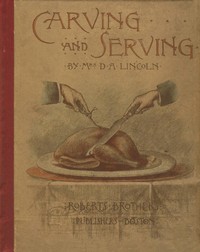
The catalog record for Carving and Serving — Key Ideas to Explore provides practical reading context through 16,790 words, 1 hr 13 min estimated reading time, and 4 detected text sections.
The text analysis averages about 20.2 words per sentence, while the detected sections provide another way to judge how the source is divided.
Project Gutenberg metadata also associates the work with “Cooking,” connecting these edition facts with the source record’s subject description.
Explore this collection
These alternatives are selected using recorded categories and estimated reading time.
About 51 minutes
Home Economics
11,510 recorded words. 22 minutes difference from this book's estimate.
View Gutenberg source #63052About 96 minutes
Home Economics
22,077 recorded words. 23 minutes difference from this book's estimate.
View Gutenberg source #43643About 50 minutes
Home Economics
11,277 recorded words. 23 minutes difference from this book's estimate.
View Gutenberg source #49833Search stored excerpts and compare books → Choose by your preferences →
Choices use stored catalog measurements. Estimates vary with reading speed. A shared category is a catalog label, not a claim that two books have the same argument or literary quality.
Search reads excerpt text stored with this catalog and links to its associated Gutenberg record. The connection is stored in the site database; this tool does not recheck that every excerpt is word-for-word identical to that external record. Excerpt search does not cover every chapter and does not verify historical publication dates.
Catalog snapshot checked: 2026-09-26. Coverage: 91 public books, 91 available source excerpts.
Calculated from edition completeness, EPUB availability, text structure and catalogue metadata. Not a user rating.
Total of 100 points, scaled to a 2.5-5.0 range. Editions with an empty description or a missing EPUB file are not scored.
Public-domain source text
The source text is kept in the dedicated reader, separate from this catalogue record and its commentary.
Mrs. D.A. Lincoln opens Carving and Serving by acknowledging repeated requests for a lecture on carving, but she insists that watching a person carve a few times is insufficient. The manual, she writes, is not for special occasions or those who can employ a skilled carver, but for everyday home life. She explicitly rejects the use of diagrams, arguing that pictures show only the surface and give no hint of what lies inside—bones, gristle, and tendons. This pragmatic, anti-illustration stance sets the tone for a text that relies entirely on precise verbal description.
Lincoln’s decision to omit diagrams is a defining structural choice. She states that such illustrations “seldom prove helpful” because the actual joint or fowl bears faint resemblance to a picture. Instead, she relies on detailed spatial language: “place the fork in the middle of the back,” “cut several slices from each side of the loin parallel with the backbone.” The instructions for baked fish are especially intricate, describing how to skewer the fish into an S-shape before cooking, then carve by making an incision along each side of the backbone. The result is a text that demands careful reading and mental visualization, rewarding those who follow the sequence step by step.
The manual’s pace shifts markedly between sections. General directions move slowly, explaining principles and the anatomy of obstacles. Later sections accelerate into brisk, imperative lists: “Remove the shoulders… Turn them back and cut through the joint.” For sweetbreads, chops, and cutlets, the instruction is a single sentence: “These are not divided, one being served to each person.” The fish section slows again, with careful notes on avoiding broken flakes and serving bone-free portions. This variation mirrors the actual rhythm of carving—pausing to assess structure, then executing quick, decisive cuts.
Lincoln’s narrative voice is direct, authoritative, and occasionally wry. She notes that a drop of gravy on the plate edge “will offend a fastidious taste.” She advises that scalloped dishes should be served with a spoon, and meat pies require a broad knife and spoon, “with the crust or browned side up.” Her tone is that of a teacher who has fielded many questions: the opening paragraph reproduces a reader’s plea, “my husband says he will come if you will.” This blend of practicality and mild humor gives the manual a conversational quality, even as it delivers precise technical instructions.
Readers approaching Carving and Serving should expect to read actively, perhaps with a knife and joint at hand. Lincoln’s method rewards those who follow her verbal maps rather than seeking quick visual shortcuts. The manual is best used as a reference for specific dishes—consult the relevant section before carving, rather than reading straight through. Its value lies in the careful attention to bone structure, grain, and presentation that transforms a routine task into a practiced art.
Sometimes the quietest books stay with you longest. That manual on carving felt less like instruction and more like a patient friend showing you where the bones hide. It made me think of First lessons in the principles of cooking — Reading Companion, which holds a gentleness for fundamentals, the why behind the heat. Both simply whispered, not shouted.
Create a short personal record of your experience with this book.