About 32 minutes
Faster Ways to Favorite Dishes With the New Minute Tapioca — Reading Notes
Historical Cookbooks
7,258 recorded words. 1 minutes difference from this book's estimate.
View Gutenberg source #65502
Before opening Season's best dishes for 2 or 4 or 6 — Text and Context, the edition data offers a quick orientation: 6,996 words, 31 min estimated reading time, and 8 detected text sections.
The text analysis averages about 13.9 words per sentence, while the detected sections provide another way to judge how the source is divided.
Project Gutenberg metadata also associates the work with “Cooking, American,” connecting these edition facts with the source record’s subject description.
Explore this collection
These alternatives are selected using recorded categories and estimated reading time.
About 32 minutes
Historical Cookbooks
7,258 recorded words. 1 minutes difference from this book's estimate.
View Gutenberg source #65502About 30 minutes
Historical Cookbooks
6,722 recorded words. 1 minutes difference from this book's estimate.
View Gutenberg source #65562About 27 minutes
Historical Cookbooks
6,094 recorded words. 4 minutes difference from this book's estimate.
View Gutenberg source #65743Search stored excerpts and compare books → Choose by your preferences →
Choices use stored catalog measurements. Estimates vary with reading speed. A shared category is a catalog label, not a claim that two books have the same argument or literary quality.
Search reads excerpt text stored with this catalog and links to its associated Gutenberg record. The connection is stored in the site database; this tool does not recheck that every excerpt is word-for-word identical to that external record. Excerpt search does not cover every chapter and does not verify historical publication dates.
Catalog snapshot checked: 2026-09-26. Coverage: 91 public books, 91 available source excerpts.
Calculated from edition completeness, EPUB availability, text structure and catalogue metadata. Not a user rating.
Total of 100 points, scaled to a 2.5-5.0 range. Editions with an empty description or a missing EPUB file are not scored.
Public-domain source text
The source text is kept in the dedicated reader, separate from this catalogue record and its commentary.
Mary Lee Taylor’s 1949 booklet for the Pet Milk Company addresses the reader as “Dear Friend” and immediately frames holiday cooking as a memory-making activity. The voice is warm and direct, promising that the recipes will save time without sacrificing quality. Taylor repeatedly emphasizes that Pet Milk—evaporated whole milk concentrated to double richness—can replace cream and butter at lower cost, a practical pitch woven into the personal tone.
The recipes are organized by serving size (2, 4, or 6), a structural choice that sets this booklet apart from standard cookbooks. Each ingredient list appears in three columns, allowing the cook to scale dishes without mental arithmetic. This format, along with the index and suggested menus, suggests a focus on efficiency and adaptability for small households or holiday gatherings.
Taylor’s prose blends instruction with encouragement. She writes that Butterscotch Balls and Coconut Kisses are “so simple to make there need never be an empty candy jar,” and invites a “junior” cook to try them. The phrase “she’ll be so proud of her success” reveals an audience of mothers and children, not professional chefs. The language is conversational: “I haven’t forgotten your Christmas dinner” and “Perhaps you’re thinking all these good things take extra amounts of expensive butter and cream.” Taylor anticipates the reader’s concerns and counters them with product benefits. The word “you” appears frequently, creating a one-on-one rapport. This direct address, combined with the signature at the end of the letter, gives the booklet the feel of a personal correspondence rather than a corporate advertisement.
The most distinctive structural feature is the triple-column ingredient list. For example, Nut Fudge lists cocoa, sugar, corn syrup, Pet Milk, and water in columns for 1⅓ pounds and 2¾ pounds. The Pork Chop Dinner provides columns for 2, 4, and 6 servings, with specific amounts like “2 (⅔ lb.)” and “4 (1⅓ lbs.).” This layout eliminates the need for the cook to halve or double quantities. The directions remain unified, with parenthetical notes when timing differs (e.g., “bake until firm, or about 35 minutes [45 minutes]”). The booklet also includes a note about altitude adjustments up to 5,000 or 7,000 feet, offering to send specially adjusted recipes—a practical detail that underscores the publisher’s commitment to reliability.
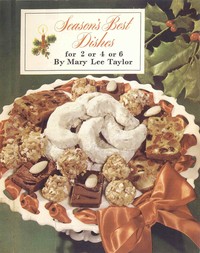
The booklet’s pacing shifts between dense recipe blocks and visual breaks. Two sample menus—“Party Food to a Man’s Taste” and “Family Meal Starring Dessert”—appear as interleaved pages, listing dishes like Bacon Rarebit and Easy Fruit Coffee Cake. These menus serve as resting points, guiding the reader toward a complete meal rather than a single dish. The front cover photograph (referenced in the Nut Fudge and Quick Fruit Cake recipes) provides a visual anchor, though the text does not describe it. The index, placed early, allows quick navigation. The overall rhythm alternates between the personal letter, the index, the scaled recipes, and the menus, creating a structure that feels both efficient and hospitable.
Readers approaching this booklet should pay attention to the serving-size columns and the altitude notes, which are integral to the recipes’ design. The personal letter at the beginning sets a tone of friendly expertise, but the real value lies in the precise scaling and the product-specific substitutions. The booklet is best used as a practical tool for holiday cooking, not a historical artifact to be read cover to cover.
Flipping through Season's Best Dishes, I was struck by how gently it guides a nervous cook—each ingredient weighed, each step explained with patience. That reassuring hand reminded me of another quiet volume, The Chemistry of Cookery — Reading Companion, which turns kitchen curiosity into calm understanding. Both feel like trusted friends, whispering there is no rush, just small truths to learn slowly.
Use these questions to collect your thoughts before moving on.