About 30 minutes
30 Tempting Spaghetti Meals: Easy, Economical, Delicious — Key Ideas to Explore
Historical Cookbooks
6,722 recorded words. 3 minutes difference from this book's estimate.
View Gutenberg source #65562
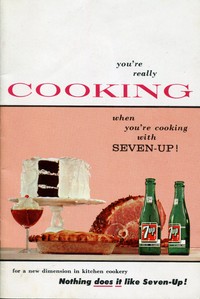
You're really cooking when you're cooking with Seven-Up! — A Closer Reading can be approached with a clearer sense of reading commitment from its source measurements: 6,094 words, 27 min estimated reading time, and 1 detected text section.
The text analysis averages about 14.2 words per sentence, while the detected sections provide another way to judge how the source is divided.
Project Gutenberg metadata also associates the work with “Cooking, American,” connecting these edition facts with the source record’s subject description.
Explore this collection
These alternatives are selected using recorded categories and estimated reading time.
About 30 minutes
Historical Cookbooks
6,722 recorded words. 3 minutes difference from this book's estimate.
View Gutenberg source #65562About 31 minutes
Historical Cookbooks
6,996 recorded words. 4 minutes difference from this book's estimate.
View Gutenberg source #70259About 32 minutes
Historical Cookbooks
7,258 recorded words. 5 minutes difference from this book's estimate.
View Gutenberg source #65502Search stored excerpts and compare books → Choose by your preferences →
Choices use stored catalog measurements. Estimates vary with reading speed. A shared category is a catalog label, not a claim that two books have the same argument or literary quality.
Search reads excerpt text stored with this catalog and links to its associated Gutenberg record. The connection is stored in the site database; this tool does not recheck that every excerpt is word-for-word identical to that external record. Excerpt search does not cover every chapter and does not verify historical publication dates.
Catalog snapshot checked: 2026-09-26. Coverage: 91 public books, 91 available source excerpts.
Calculated from edition completeness, EPUB availability, text structure and catalogue metadata. Not a user rating.
Total of 100 points, scaled to a 2.5-5.0 range. Editions with an empty description or a missing EPUB file are not scored.
Public-domain source text
The source text is kept in the dedicated reader, separate from this catalogue record and its commentary.
The booklet opens by addressing “housewives who are always alert for ways to put ‘something extra’ into their favorite recipes,” immediately positioning 7-Up as a versatile kitchen ingredient rather than merely a beverage. The recipes that follow demonstrate this claim: 7-Up appears as a baste for beef, pork, lamb, turkey, and wild duck, as a moistener for fruit pies, and as a mixer in a batter for “7-Up Broncos”—hot dogs dipped in a 7-Up-laced pancake batter and deep-fried. The tone is enthusiastic and instructional, with frequent exclamation points and phrases like “Nothing does it like Seven-Up!” that reinforce the brand’s promotional purpose.
The most prominent use of 7-Up in this collection is as a basting liquid for meats and fowl. The instructions for roasts specify adding 7-Up “as required” after an initial browning, while turkey recipes call for three or four 7-ounce bottles. A notable claim is made for wild duck: “Seven-Up takes away any ‘gamey’ taste and still preserves the natural flavor.” This assertion—that a lemon-lime soda can neutralize strong flavors while keeping the meat’s character—is a key selling point. The basting method is presented as a simple upgrade to standard roasting, requiring no special equipment. The booklet does not explain why 7-Up works chemically, but the repeated emphasis on “tangy” and “sparkling” results suggests the carbonation and acidity are meant to tenderize and add brightness.
Beyond meat, 7-Up is deployed in sweets and beverages with equal confidence. For fruit pies, the cook is told to “sprinkle four (4) tablespoons of 7-Up over the fruit filling before putting on the top crust,” promising that the “lemon-lime piquancy … brings out the flavor of the fruit.” A party punch features “7-Up ‘icebergs’”—frozen blocks of soda that, when melted, “don’t dilute the punch.” Dried fruits can be simmered in 7-Up until tender, and canned fruit cocktail is improved by replacing its syrup with 7-Up. Perhaps most striking is the suggestion to mix chilled 7-Up with cold milk in equal parts, “Do not stir,” creating a drink “especially pleasing to children.” These recipes blur the line between cooking and direct consumption, treating the soda as both ingredient and mixer.
The catalog subjects list this work under “Cooking, American; Cookbooks; Cooking (Soft drinks),” but the excerpts reveal a text that is as much a brand advertisement as a recipe collection. The copyright notice dates to 1957, and the booklet’s language—“Now you’re really cooking … when you’re cooking with 7-Up!”—echoes the slogan in the title. Recipes are designed to increase household usage of the product: a single turkey recipe consumes three to four bottles, and the “7-Up Broncos” appetizer pairs the cooked item with “chilled 7-Up” for serving. The closing pages expand the sales pitch beyond cooking, urging readers to “serve 7-Up with food … making it a part of mealtime and party menus.” The cookbook thus functions as a point-of-sale tool, embedding the product into everyday meal preparation.
Readers approaching this booklet should recognize it as a period marketing artifact rather than a comprehensive cookbook. The recipes are brief and assume basic cooking knowledge; measurements are given in cups and bottles, not weights. The emphasis on “party touch” and “company dish” suggests the intended audience is a mid-century homemaker seeking novelty. For modern cooks, the recipes offer a glimpse into postwar American food culture, where convenience products and branded ingredients were celebrated as innovations.
That Seven-Up booklet makes me think of a time when cooking felt like playful invention, soda sneaking into everything. There's a warmth in that old-world practicality. A similar quiet charm lives in The Stag Cook Book: Written for Men by Men — Key Ideas to Explore, almost like holding a friend's handwritten note from another era. It lingered with me the same way, a small, genuine piece of someone's daily life.
A brief reflection can help important ideas stay with you longer.