About 531 minutes
Miss Parloa's New Cook Book — Reading Companion
Home Economics
122,081 recorded words. 34 minutes difference from this book's estimate.
View Gutenberg source #6745
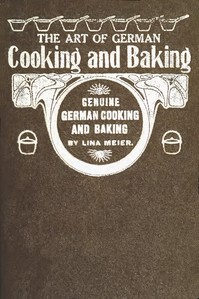
Before opening The Art of German Cooking and Baking Revised and Enlarged Edition — Reading Companion, the edition data offers a quick orientation: 129,906 words, 9 hr 25 min estimated reading time, and 44 detected text sections.
The text analysis averages about 11.7 words per sentence, while the detected sections provide another way to judge how the source is divided.
Project Gutenberg metadata also associates the work with “Cooking, German,” connecting these edition facts with the source record’s subject description.
Explore this collection
These alternatives are selected using recorded categories and estimated reading time.
About 531 minutes
Home Economics
122,081 recorded words. 34 minutes difference from this book's estimate.
View Gutenberg source #6745About 509 minutes
Home Economics
117,060 recorded words. 56 minutes difference from this book's estimate.
View Gutenberg source #56540About 378 minutes
Home Economics
86,810 recorded words. 187 minutes difference from this book's estimate.
View Gutenberg source #54568Search stored excerpts and compare books → Choose by your preferences →
Choices use stored catalog measurements. Estimates vary with reading speed. A shared category is a catalog label, not a claim that two books have the same argument or literary quality.
Search reads excerpt text stored with this catalog and links to its associated Gutenberg record. The connection is stored in the site database; this tool does not recheck that every excerpt is word-for-word identical to that external record. Excerpt search does not cover every chapter and does not verify historical publication dates.
Catalog snapshot checked: 2026-09-26. Coverage: 91 public books, 91 available source excerpts.
Calculated from edition completeness, EPUB availability, text structure and catalogue metadata. Not a user rating.
Total of 100 points, scaled to a 2.5-5.0 range. Editions with an empty description or a missing EPUB file are not scored.
Public-domain source text
The source text is kept in the dedicated reader, separate from this catalogue record and its commentary.
Lina Meier’s The Art of German Cooking and Baking (1922) is organized into 26 chapters spanning 1,250 recipes, from soups to confectionery. The preface emphasizes clarity and practicality, targeting brides and beginners. The book’s structure—moving from basic ingredients to elaborate composed dishes—creates a pedagogical arc. Recurring images of careful preparation, such as boiling vegetables separately to preserve texture, and the frequent use of precise weights and measures (e.g., “3 coffee cups, level” for flour) anchor the work in a domestic science tradition. The movement between simple and complex recipes, like the progression from basic potato salad to truffle salad, illustrates a methodical building of skills.
The 26-chapter structure moves from foundational elements (soups, meats) to composed dishes (salads, desserts) and finally to specialized sections like “Cookery for Invalids.” This progression mirrors a course of instruction, with each chapter building on previous techniques. For instance, Chapter 13 (Salads) includes recipes that reuse cooked meats and vegetables from earlier chapters, such as “Mixed Salad with Meat” (No. 29), which calls for beef, veal, or poultry prepared elsewhere. The chapter on “Dressings or Gravies” (Chapter 10) precedes salads, ensuring the reader has the necessary sauces. This deliberate sequencing suggests Meier intended the book as a comprehensive curriculum, not merely a collection of recipes.
Throughout the excerpts, Meier insists on exact measurements and techniques. The “Reliable Weights and Measures” table at the start standardizes terms like “coffee cup” and “tbsp., well-rounded.” In salad recipes, instructions to “cook each separately until tender” and “mix carefully” emphasize control over texture. The mayonnaise dressing (No. 28) requires stirring “constantly” in a double boiler until thick, then cooling before adding oil. This attention to detail recurs in the truffle salad (No. 31), where preserved truffles are “scraped and sliced fine” and fresh ones are “brushed well in much water.” Such precision reflects a scientific approach to cooking, aiming for reproducible results.
The salad chapter exemplifies a clear progression from basic to ornate. Early recipes like “Fine Mixed Vegetable Salad” (No. 28) combine boiled vegetables with a simple oil-and-vinegar dressing. Later entries introduce mayonnaise, truffles, and sweetbreads. “Champignon Salad” (No. 30) pairs mushrooms with boiled sweetbreads and sour cream, while “Truffle Salad” (No. 31) uses bouillon-cooked truffles and white wine. The most complex, “Mixed Salad with Meat” (No. 29), integrates multiple vegetables, pickles, apples, and meat, with an optional mayonnaise. This escalation in ingredients and technique mirrors the book’s overall trajectory from fundamentals to festive dishes.
Meier frequently describes arranging salads on lettuce leaves and garnishing with olives or parsley. In No. 28, the salad is “piled up in the center” of a dish lined with lettuce; No. 30 is “arranged on the head lettuce leaves, strewn with parsley and garnished with olives.” This visual presentation—layering, centering, garnishing—appears across multiple recipes, suggesting an aesthetic ideal of neatness and symmetry. The instruction to “mix carefully” to avoid breaking pieces (No. 27) reinforces a hands-on, deliberate approach. These recurring images of assembly and decoration give the book a consistent visual language, even as the ingredients become more elaborate.
Readers approaching this edition will benefit from noting the book’s internal progression: earlier chapters provide the building blocks for later, more complex dishes. The precise measurements and methodical instructions reward careful reading, especially for those new to German cooking. Meier’s emphasis on separate cooking and gentle mixing offers a window into early 20th-century domestic science, where control over texture and temperature was paramount. This is a cookbook designed to be studied as much as used, with each recipe contributing to a broader culinary education.
Leafing through Meier’s precise salad layers, I felt that patient, orderly quality again—the same quiet diligence I found later in The Healthy Life Cook Book, 2d ed. — Edition Insights. Her measured vinegar, his plain grains; both seemed to trust routine over flourish. Odd how such practical pages hold a kind of tenderness.
A brief reflection can help important ideas stay with you longer.