About 531 minutes
Miss Parloa's New Cook Book — Reading Companion
Home Economics
122,081 recorded words. 22 minutes difference from this book's estimate.
View Gutenberg source #6745
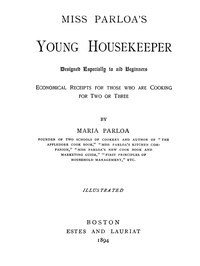
The catalog record for Miss Parloa's Young Housekeeper Designed Especially to Aid Beginners; Economical Receipts for Those Who Are Cooking for Two or Three — A Reader’s Guide provides practical reading context through 117,060 words, 8 hr 29 min estimated reading time, and 36 detected text sections.
The text analysis averages about 13.0 words per sentence, while the detected sections provide another way to judge how the source is divided.
Project Gutenberg metadata also associates the work with “Cooking, American,” connecting these edition facts with the source record’s subject description.
Explore this collection
These alternatives are selected using recorded categories and estimated reading time.
About 531 minutes
Home Economics
122,081 recorded words. 22 minutes difference from this book's estimate.
View Gutenberg source #6745About 565 minutes
Home Economics
129,906 recorded words. 56 minutes difference from this book's estimate.
View Gutenberg source #63883About 378 minutes
Home Economics
86,810 recorded words. 131 minutes difference from this book's estimate.
View Gutenberg source #54568Search stored excerpts and compare books → Choose by your preferences →
Choices use stored catalog measurements. Estimates vary with reading speed. A shared category is a catalog label, not a claim that two books have the same argument or literary quality.
Search reads excerpt text stored with this catalog and links to its associated Gutenberg record. The connection is stored in the site database; this tool does not recheck that every excerpt is word-for-word identical to that external record. Excerpt search does not cover every chapter and does not verify historical publication dates.
Catalog snapshot checked: 2026-09-26. Coverage: 91 public books, 91 available source excerpts.
Calculated from edition completeness, EPUB availability, text structure and catalogue metadata. Not a user rating.
Total of 100 points, scaled to a 2.5-5.0 range. Editions with an empty description or a missing EPUB file are not scored.
Public-domain source text
The source text is kept in the dedicated reader, separate from this catalogue record and its commentary.
Maria Parloa addresses her 1893 manual directly to "young wives" who have just begun keeping house for two or three, responding to years of appeals from students. The preface frames the book as a practical answer to the question of how to buy supplies for a small family and cook economically without sacrificing an attractive table. Parloa explicitly targets those with moderate incomes, though she includes advice for households with servants. The tone is instructional and sympathetic, promising that "strict adherence to careful instructions will, with a little good sense thrown in, enable a young housekeeper to accomplish wonders."
Parloa's recipes demand exact measurements and specific timings, reflecting a scientific approach to cooking. In the recipe for Fried Bread, she instructs the cook to test the lard temperature by dropping in a single square of bread: if it browns in "one minute and a half," the fat is ready. The bread squares must be fried for "about a minute and a half" and stirred with a fork for even browning. Such precise language appears throughout, as in the Welsh Rarebit, where the mixture must become "a smooth, creamy mass" before being spread on toast. These details reveal Parloa's belief that success depends on replicable steps, not guesswork.
The book's subtitle promises "Economical Receipts for Those Who Are Cooking for Two or Three," and Parloa consistently emphasizes thrift. The preface notes that many housekeepers "strive" for an attractive table "without knowing the best way to reach the goal" of economy. Recipes often include instructions for reusing fat: after frying bread, the lard should be "strained through a piece of cheese-cloth" and saved. The Maple Syrup from Sugar recipe advises buying maple sugar in spring and storing it for year-round syrup. These small economies are woven into the instructions, teaching beginners to minimize waste.
Parloa frequently offers variations within recipes, encouraging cooks to adapt based on available ingredients. The Batter for Fruit Fritters is described as suitable "for any kind of fruit," and the Apple Fritter recipe is followed by a list of alternatives: "Peaches, bananas, oranges, grapes, pears, etc., may be cooked in the form of fritters." Similarly, the Milk Toast recipe notes that "Indian, brown, or graham bread may be used." This flexibility reflects the realities of a small household, where ingredients might not always be on hand, and the cook must improvise without compromising quality.
Parloa's preface establishes a direct, personal relationship with her reader. She recounts that "earnest appeals have been made to me" over fifteen years of teaching, and she has "at last set about telling them" what they need to know. The phrase "young wives" signals her intended audience, and she acknowledges that "not all who begin to build a home are obliged to count every dollar." Yet her primary aim is "to lend a hand to those whose incomes are moderate." This framing positions the book as a mentor's response to real needs, not a generic collection of recipes.
Parloa's manual rewards a reading that attends to the how as much as the what: the precise timings, the reuse of ingredients, the quiet insistence on economy. Readers will find that the recipes themselves are lessons in resourcefulness, and the preface offers a clear sense of the author's pedagogical mission. The book is best approached as a period document of domestic science, where every measurement and every instruction carries the weight of Parloa's experience.
There's something honest about Miss Parloa’s careful little lessons in stretching a pound of beef or warming yesterday’s bread, a quiet resourcefulness that feels almost like a secret kept between us. Somehow, that same thoughtful frugality drifts into my memory of Camping and camp cooking — Reading Companion — making do with a tin cup and a small fire, yet still eating well. Both feel like old friends who never rush you.
Capture what you thought, learned, and would like to remember.