About 115 minutes
The Healthy Life Cook Book, 2d ed. — Edition Insights
Home Economics
26,339 recorded words. 0 minutes difference from this book's estimate.
View Gutenberg source #10632
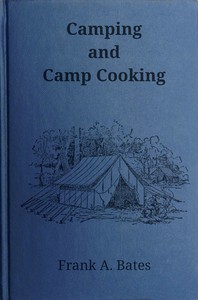
Camping and camp cooking — Reading Companion can be approached with a clearer sense of reading commitment from its source measurements: 26,221 words, 1 hr 55 min estimated reading time, and 17 detected text sections.
The text analysis averages about 21.7 words per sentence, while the detected sections provide another way to judge how the source is divided.
Project Gutenberg metadata also associates the work with “Camping,” connecting these edition facts with the source record’s subject description.
Explore this collection
These alternatives are selected using recorded categories and estimated reading time.
About 115 minutes
Home Economics
26,339 recorded words. 0 minutes difference from this book's estimate.
View Gutenberg source #10632About 109 minutes
Home Economics
24,915 recorded words. 6 minutes difference from this book's estimate.
View Gutenberg source #14066About 123 minutes
Home Economics
28,243 recorded words. 8 minutes difference from this book's estimate.
View Gutenberg source #75832Search stored excerpts and compare books → Choose by your preferences →
Choices use stored catalog measurements. Estimates vary with reading speed. A shared category is a catalog label, not a claim that two books have the same argument or literary quality.
Search reads excerpt text stored with this catalog and links to its associated Gutenberg record. The connection is stored in the site database; this tool does not recheck that every excerpt is word-for-word identical to that external record. Excerpt search does not cover every chapter and does not verify historical publication dates.
Catalog snapshot checked: 2026-09-26. Coverage: 91 public books, 91 available source excerpts.
Calculated from edition completeness, EPUB availability, text structure and catalogue metadata. Not a user rating.
Total of 100 points, scaled to a 2.5-5.0 range. Editions with an empty description or a missing EPUB file are not scored.
Public-domain source text
The source text is kept in the dedicated reader, separate from this catalogue record and its commentary.
Frank A. Bates addresses his book to the “business man, the clerk, the mechanic”—anyone who wishes to camp out and “still keep his self-respect.” The opening introduction frames camping as a response to a “strain of wild blood” that impels people to leave the haunts of man, yet it quickly grounds that romantic impulse in practical needs: three square meals a day, food “not too full of ashes,” and cooking methods that differ only slightly from home. Bates positions himself as an experienced woodsman who has spent “many months in the woods” and fitted out many parties, lending authority to the detailed instructions that follow.
Bates writes in a direct, sometimes wry tone that treats the reader as a fellow camper rather than a student. When discussing game, he notes: “I might read you a homily on the sin of killing the creatures of the wood and field; but I am not going to do it, for several reasons. First ’twould do no good, for you would keep on killing. Second, it is none of my business anyway.” This conversational aside reveals a pragmatic, non-judgmental stance. Elsewhere, he uses second-person commands (“Have the fry pan hissing hot”) and assumes the reader will adapt recipes to taste. The voice is that of a seasoned mentor who values results over sentiment.
The cooking instructions are methodical, often breaking a dish into numbered steps or parallel options. For hash, Bates offers three variations: warming with pork fat, forming croquettes dipped in corn meal, or mixing with eggs and deep-frying. Each variant specifies heat levels (“as hot as it can be without burning”) and sequence. The barbecue dressing recipe lists exact proportions and a basting technique using a “bit of clean cloth or sponge tied on the end of a stick.” These procedures assume the reader has basic equipment but needs guidance on timing and technique to avoid common failures like burnt onions or undercooked meat.
Bates repeatedly justifies his advice with health concerns. He insists on bleeding game immediately, warning that “the flesh of an animal that has not been bled is not fit to eat.” He advises letting “animal heat” dissipate before cooking, citing stomach discomfort as “proof positive that it is not healthful.” Fish is the only exception. The second edition adds an appendix on health care, though its content is not excerpted. These warnings reflect a broader concern that poor camp cooking leads to dyspepsia, which Bates aims to prevent. His tone is firm but not alarmist, treating the reader as capable of following reason.
Readers should note that the excerpts cover only the introduction and a portion of the cooking section; the chapters on camping equipment, site selection, and fish cleaning (by contributor Leslie F. Bosworth) are not represented. Bates’s emphasis on practicality and his aversion to “professional trapper” methods suggest the full book balances comfort with woodcraft. The recipes reward careful attention to heat management and ingredient ratios, reflecting a cook who expects precision even in the wild.
Flipping through Bates’s sturdy campfire menus, I found myself missing the warm, certain rhythm of my grandmother’s kitchen. His practical broths and simple roasts felt like distant cousins to the patient, loving precision in The Art of German Cooking and Baking Revised and Enlarged Edition — Reading Companion. Both books understand that a full pot is its own quiet kind of homecoming.
A brief reflection can help important ideas stay with you longer.