About 115 minutes
The Healthy Life Cook Book, 2d ed. — Edition Insights
Home Economics
26,339 recorded words. 8 minutes difference from this book's estimate.
View Gutenberg source #10632
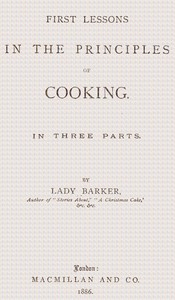
The source record for First lessons in the principles of cooking — Reading Companion measures this digital text at 28,243 words, 2 hr 3 min estimated reading time, and 7 detected text sections.
The text analysis averages about 32.9 words per sentence, while the detected sections provide another way to judge how the source is divided.
Project Gutenberg metadata also associates the work with “Cooking,” connecting these edition facts with the source record’s subject description.
Explore this collection
These alternatives are selected using recorded categories and estimated reading time.
About 115 minutes
Home Economics
26,339 recorded words. 8 minutes difference from this book's estimate.
View Gutenberg source #10632About 115 minutes
Home Economics
26,221 recorded words. 8 minutes difference from this book's estimate.
View Gutenberg source #73671About 134 minutes
Home Economics
30,734 recorded words. 11 minutes difference from this book's estimate.
View Gutenberg source #38193Search stored excerpts and compare books → Choose by your preferences →
Choices use stored catalog measurements. Estimates vary with reading speed. A shared category is a catalog label, not a claim that two books have the same argument or literary quality.
Search reads excerpt text stored with this catalog and links to its associated Gutenberg record. The connection is stored in the site database; this tool does not recheck that every excerpt is word-for-word identical to that external record. Excerpt search does not cover every chapter and does not verify historical publication dates.
Catalog snapshot checked: 2026-09-26. Coverage: 91 public books, 91 available source excerpts.
Calculated from edition completeness, EPUB availability, text structure and catalogue metadata. Not a user rating.
Total of 100 points, scaled to a 2.5-5.0 range. Editions with an empty description or a missing EPUB file are not scored.
Public-domain source text
The source text is kept in the dedicated reader, separate from this catalogue record and its commentary.
Lady Barker opens First Lessons in the Principles of Cooking with a blunt social argument: waste in the kitchen is a moral and practical failure, rooted not in laziness but in ignorance of the chemical composition of food. She positions her book as a middle ground—neither a general household guide nor a conventional cookery book—but a compact explanation of why certain foods nourish more and why specific methods yield digestible, economical meals. Drawing on the work of practical chemists, she promises to condense the reasons behind everyday cooking choices.
From the first paragraph, Barker frames cooking as a bounden duty for every head of a household, regardless of means. This moral tone recurs throughout: waste is an evil to be remedied by knowledge, not theory. She insists that ignorance of the relative nutritive value of foods lies at the root of poor kitchen practice. Her language is direct and authoritative, yet she avoids scolding; instead, she offers herself as a conduit for scientific truths. The phrase “reasons why” appears repeatedly, signaling her intent to demystify cooking through cause-and-effect reasoning rather than rote instruction.
Barker’s instructions for broth reveal her attention to detail and her disdain for haste. She specifies “a nice, warm, comforting, clean-tasting basin of broth” as the goal, contrasting it with the “weak, greasy liquid” of careless preparation. Key technical points include: using well-washed pearl barley or rice (even inferior rice works), adding vegetables and herbs tied together, and—crucially—not removing meat and bones during simmering. She warns against the common mistake of too much water, which produces weak meat-tea instead of strong soup. Her advocacy for macaroni as a cheap, pure form of wheaten flour shows her practical bent: she recommends it boiled with even a little broth for a wholesome change.
Barker grounds her preference for beef in chemical reasoning: beef contains the most iron, which as oxide is a chief constituent of blood. She notes that nutriment for carnivorous animals derives from blood, so a strengthening diet must include iron. This leads her to assert that beef-tea is instinctively preferred by the sick, while a laboring man buys beef over other meats. She also offers alternatives—veal and lean beef for delicate broth, chicken or rabbit for variety—but cautions that rabbit is not advisable for invalids. The passage blends nutritional science with observed behavior, reinforcing her argument that understanding composition leads to better, cheaper eating.
In Lesson VIII, Barker turns to the kitchen fire itself, calling it “a good cooking fire—a clear, bright fire, which, without being a roaring furnace, shall yet be equal to any emergency.” She diagnoses a common failure: the cook lets the fire burn down, then dumps half a coal-scuttle on the embers, making the fire useless for two hours. Her remedy is constant small additions of coal, so that even when not cooking, a small bright fire is maintained. The passage is a miniature case study in practical observation—she knows exactly what happens when a fire has “just been made up” and uses that as a teachable moment. The tone is firm but not condescending, aimed at the lady of the house who may not see the kitchen fire’s daily challenges.
Barker’s voice is that of a knowledgeable instructor who respects her reader’s intelligence and moral seriousness. She does not merely list recipes; she explains the principles behind each step, from the chemistry of beef to the physics of coal. Readers will find that the book’s value lies less in specific dishes than in its methodical approach to cooking as a rational, economical craft. For those willing to study the “reasons why,” it offers a foundation that outlasts any single recipe.
I found myself thinking about that old Lady Barker manual the other day—how she made the chemistry of a broth feel like a quiet secret she was letting me in on. It reminded me of another gentle voice, Miss Parloa's Young Housekeeper Designed Especially to Aid Beginners; Economical Receipts for Those Who Are Cooking for Two or Three — A Reader’s Guide, which stays with you the same way, like a patient hand over yours at the stove.
Create a short personal record of your experience with this book.