Knox Eat and Reduce Plan; Including Choice-of-Foods Chart — Background and Themes

(0 User reviews)   366
In Category - Home Economics
Charles B. Knox Gelatine Co. Project Gutenberg 2020 Not confirmed
Cooking (Gelatin); Reducing diets Readers of public-domain and historical texts
Project Gutenberg digital edition en

Edition facts

Words 11,510
Reading time 51 min
Text sections 3

The source record for Knox Eat and Reduce Plan; Including Choice-of-Foods Chart — Background and Themes measures this digital text at 11,510 words, 51 min estimated reading time, and 3 detected text sections.

The text analysis averages about 16.2 words per sentence, while the detected sections provide another way to judge how the source is divided.

Project Gutenberg metadata also associates the work with “Cooking (Gelatin),” connecting these edition facts with the source record’s subject description.

Explore this collection

Compare your next read

These alternatives are selected using recorded categories and estimated reading time.

Search stored excerpts and compare books → Choose by your preferences →

How these choices and excerpts are prepared

Choices use stored catalog measurements. Estimates vary with reading speed. A shared category is a catalog label, not a claim that two books have the same argument or literary quality.

Search reads excerpt text stored with this catalog and links to its associated Gutenberg record. The connection is stored in the site database; this tool does not recheck that every excerpt is word-for-word identical to that external record. Excerpt search does not cover every chapter and does not verify historical publication dates.

Catalog snapshot checked: 2026-09-26. Coverage: 91 public books, 91 available source excerpts.

This 1957 diet plan from Charles B. Knox Gelatine Co. uses a Choice-of-Foods chart based on diabetic exchange lists, emphasizing unflavored gelatin as a low-calorie ingredient. Recipes like Spanish Cream and Perfection Salad show how to create varied meals without hunger, while the Q&A format addresses common dieting concerns.
Share
Editorial Edition Score 4.5/5

Calculated from edition completeness, EPUB availability, text structure and catalogue metadata. Not a user rating.

How this score is calculated
  • Description quality20 pts
  • Title & short description10 pts
  • Source metadata20 pts
  • Text length15 pts
  • Chapters / structure15 pts
  • EPUB file integrity20 pts

Total of 100 points, scaled to a 2.5-5.0 range. Editions with an empty description or a missing EPUB file are not scored.

Edition quality

Public-domain source text

Read the source text

The source text is kept in the dedicated reader, separate from this catalogue record and its commentary.

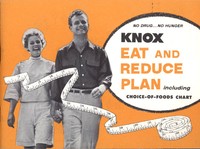
The Knox Eat and Reduce Plan, published in 1957 by the Charles B. Knox Gelatine Co., presents a weight-loss system built around unflavored gelatin and a Choice-of-Foods chart adapted from diabetic exchange lists. The plan promises “NO DRUG ... NO HUNGER” and frames dieting as a matter of “will power” and “a few simple rules of nutrition.” Rather than counting calories, users select from six food lists, each with designated serving sizes. The booklet’s Q&A format directly addresses skepticism about monotony, safety, and calorie counting, positioning the diet as both medically sound and easy to follow. Recipes such as Spanish Cream and Savory Quick Salad Dressing demonstrate how gelatin can transform low-calorie ingredients into satisfying dishes.

Borrowing from Medical Practice

The plan explicitly adapts the Food Exchange Lists developed for diabetics, a system “the medical profession has advised” for conditions where diet is “of the utmost importance.” By adjusting these exchanges to a reducing diet, the authors claim the plan “can actually improve your health as well as control your weight.” This medical borrowing gives the diet an air of authority, yet the booklet never mentions consulting a doctor before starting. The language shifts between clinical precision—listing protein, minerals, and vitamins—and reassuring simplicity: “there’s no mystery about why you’ve put on weight.” The tension between medical credibility and mass-market appeal runs throughout.

Gelatin as a Structural Ingredient

Unflavored gelatin appears in nearly every recipe, not as a flavor but as a textural tool. In dishes like Original Perfection Salad Mold, gelatin is dissolved in hot water, chilled “to unbeaten egg white consistency,” then folded with cabbage, celery, and pimiento. The same technique yields Carrot-Orange Jellied Salad and Spanish Cream, where gelatin thickens skim milk and egg yolks into a custard-like dessert. The booklet also uses gelatin to create non-caloric carbonated beverages, turning diet soda into a jelly. This emphasis on gelatin as a low-calorie binder—often labeled “Free Choice”—reflects the product’s commercial purpose while offering dieters a sense of abundance through volume and variety.

The Rhetoric of Normalcy

The plan repeatedly insists that dieters can eat “normal foods” and that family members “won’t know you’re dieting” except for smaller portions. Steak, baked potatoes, seafood, and “delicious desserts” are listed as permissible, contrasting with the “extreme or faddish” diets the plan implicitly criticizes. Yet the recipes themselves rely on non-caloric sweeteners, evaporated milk, and gelatin—ingredients far from everyday 1950s cooking. This contradiction between the promise of normalcy and the reality of specialized preparation is a key tension. The plan also frames weight control as a matter of individual willpower, ignoring broader social or economic factors, and positions itself as a “basic guide to good eating habits” for anyone, fat or thin.

The Knox Eat and Reduce Plan offers a window into mid-century diet culture, where medical authority, commercial interests, and domestic ideals intersect. Readers should note that the excerpts provide only a portion of the recipes and the full Choice-of-Foods chart; the plan’s practical usability depends on that chart and the complete food lists. The booklet’s reliance on gelatin as a universal solution invites scrutiny of how processed foods were marketed as health aids. For those interested in historical diet literature, this text is a compact example of how food companies leveraged nutritional science to sell products.

I have always felt a quiet kinship between the 1957 Knox Eat and Reduce Plan and the older The Golden Age Cook Book — Edition Insights. Where Knox finds grace in restraint, the other finds it in abundance, yet both treat the kitchen as a place of gentle arithmetic, measuring portions and pleasure with the same careful hand, whispering that nourishment was never meant to be a punishment.

There are no reviews for this eBook.

0
0 out of 5 (0 User reviews )

Add a Review

Your Rating *
There are no comments for this eBook.

Reader reflection

Before you leave, reflect on the book

Use these questions to collect your thoughts before moving on.

Your progress 0 / 10
1

What is your current status with this title?

2

How much did you enjoy the reading experience?

3

Would you encourage someone else to read it?

4

What was the reading difficulty like?

Related eBooks