About 51 minutes
Knox Eat and Reduce Plan; Including Choice-of-Foods Chart — Background and Themes
Home Economics
11,510 recorded words. 1 minutes difference from this book's estimate.
View Gutenberg source #63052
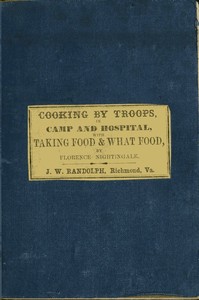
The source record for Directions for Cooking by Troops, in Camp and Hospital Prepared for the Army of Virginia, and published by order of the Surgeon General, with essays on "taking food," and — Reading Notes measures this digital text at 11,277 words, 50 min estimated reading time, and 4 detected text sections.
The text analysis averages about 21.5 words per sentence, while the detected sections provide another way to judge how the source is divided.
Project Gutenberg metadata also associates the work with “Cooking for the sick,” connecting these edition facts with the source record’s subject description.
Explore this collection
These alternatives are selected using recorded categories and estimated reading time.
About 51 minutes
Home Economics
11,510 recorded words. 1 minutes difference from this book's estimate.
View Gutenberg source #63052About 49 minutes
Home Economics
11,046 recorded words. 1 minutes difference from this book's estimate.
View Gutenberg source #64687About 46 minutes
Home Economics
10,547 recorded words. 4 minutes difference from this book's estimate.
View Gutenberg source #25007Search stored excerpts and compare books → Choose by your preferences →
Choices use stored catalog measurements. Estimates vary with reading speed. A shared category is a catalog label, not a claim that two books have the same argument or literary quality.
Search reads excerpt text stored with this catalog and links to its associated Gutenberg record. The connection is stored in the site database; this tool does not recheck that every excerpt is word-for-word identical to that external record. Excerpt search does not cover every chapter and does not verify historical publication dates.
Catalog snapshot checked: 2026-09-26. Coverage: 91 public books, 91 available source excerpts.
Calculated from edition completeness, EPUB availability, text structure and catalogue metadata. Not a user rating.
Total of 100 points, scaled to a 2.5-5.0 range. Editions with an empty description or a missing EPUB file are not scored.
Public-domain source text
The source text is kept in the dedicated reader, separate from this catalogue record and its commentary.
Florence Nightingale's Directions for Cooking by Troops, in Camp and Hospital (1861) opens with a series of recipes scaled for one hundred men, each specifying exact weights and timings. The first recipe, for coffee, instructs the cook to add half a gallon of cold water after boiling to settle the grounds—a small but telling detail that reveals the manual's practical, field-tested origins. The book is structured in two distinct parts: a sequence of numbered cooking directions for camp and hospital, followed by two essays on 'taking food' and 'what food.' This division mirrors the dual audience of cooks and nurses, and the shift from recipe to essay marks a movement from instruction to principle.
The recipes are built around precise ratios: 12 gallons of water to 3 pounds of coffee, 75 pounds of beef to 15 gallons of water for soup. Each ingredient is listed in bulk, and the instructions assume the cook will divide the batch if necessary. The repetition of 'for one hundred men' in every title creates a rhythmic structure, while the occasional note—such as 'mutton, veal or pork can be stewed in a similar manner, but will take half an hour less cooking'—adds flexibility. The recipes also include improvised alternatives: if suet is unavailable, dumplings can be made with extra water and boiled for ten minutes. These adjustments reveal a voice that anticipates scarcity.
The second half of the book, the essays, adopts a different register. Nightingale addresses the nurse directly, using phrases like 'you cannot but feel that nature knows what she is about.' The tone is more discursive, drawing on observation rather than formula. She warns against increasing the bulk of food unnecessarily: 'You have not increased the nourishment, you have not increased the renovating power of these articles, by increasing their bulk.' This principle—that quality matters more than quantity—echoes the recipes' emphasis on proper technique. The essays also introduce a recurring image: the patient's tongue, which 'always prefers tea to coffee' when dry and dirty.
Tea appears as a persistent motif. Nightingale defends it against 'wise people' who abuse it, noting that English patients crave it even when they can take nothing else. She prescribes timing: tea or coffee should not be given after 5 p.m., because early-night sleeplessness is from excitement, while early-morning sleeplessness is from exhaustion and relieved by tea. This attention to the patient's daily cycle mirrors the recipes' attention to cooking times. She also cites Lehman's experiment showing that coffee reduces bodily waste by one-fourth, grounding her advice in measurable evidence. Cocoa, by contrast, is dismissed as 'pure mockery'—an oily starch that merely increases fat.
Throughout the essays, Nightingale insists on close observation of the patient's response to food. She calls this 'almost neglected branch of nursing' and argues that the nurse's duty is to 'observe the effect of his food, and report it to the medical attendant.' This emphasis on empirical attention—watching what the patient actually eats and how he reacts—connects the essays to the recipes, which are themselves the result of trial and error. The book's structure, moving from fixed quantities to flexible principles, enacts this method: first learn the rules, then learn to see. The final paragraphs reinforce the idea that food is not merely fuel but a tool for recovery, to be adjusted by the minute.
Readers approaching this manual should attend to its dual nature: the recipes are not just instructions but records of a system designed for scarcity and speed, while the essays reveal the reasoning behind them. Nightingale's voice shifts from the imperative mood of the cook to the persuasive tone of the teacher, but both sections share a commitment to precision and adaptability. The book rewards those who read it as a document of practice rather than theory—a guide written by someone who has watched men eat and recover.
That rainy afternoon, Nightingale’s insistence on watching how tea settled a feverish man felt like a quiet lesson in patience. Her precise recipes faded, leaving only that careful gaze. Later, I found myself thinking of campfire meals, less clinical but no less attentive. A different book appeared on my shelf, almost by itself: Camping and camp cooking — Reading Companion. It held the same unhurried attention, just under open sky.
Create a short personal record of your experience with this book.