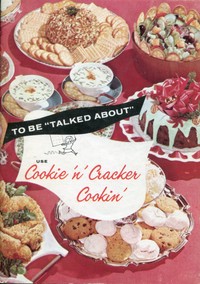
To Be "Talked About" Use Cookie 'n' Cracker Cookin' — Inside the Classic

(0 User reviews)   92
In Category - Home Economics
Elliott, Jeanette Hindman, Festen, Alfred Project Gutenberg 2021 Not confirmed
Cooking; Cookies; Crackers Readers of public-domain and historical texts
Project Gutenberg digital edition en

Edition facts

Words 11,046
Reading time 49 min
Text sections 2

The source record for To Be "Talked About" Use Cookie 'n' Cracker Cookin' — Inside the Classic measures this digital text at 11,046 words, 49 min estimated reading time, and 2 detected text sections.

The text analysis averages about 16.2 words per sentence, while the detected sections provide another way to judge how the source is divided.

Project Gutenberg metadata also associates the work with “Cooking,” connecting these edition facts with the source record’s subject description.

Explore this collection

Compare your next read

These alternatives are selected using recorded categories and estimated reading time.

Search stored excerpts and compare books → Choose by your preferences →

How these choices and excerpts are prepared

Choices use stored catalog measurements. Estimates vary with reading speed. A shared category is a catalog label, not a claim that two books have the same argument or literary quality.

Search reads excerpt text stored with this catalog and links to its associated Gutenberg record. The connection is stored in the site database; this tool does not recheck that every excerpt is word-for-word identical to that external record. Excerpt search does not cover every chapter and does not verify historical publication dates.

Catalog snapshot checked: 2026-09-26. Coverage: 91 public books, 91 available source excerpts.

A 1959 promotional cookbook from United Biscuit Company, featuring recipes that use cookies and crackers as key ingredients, from appetizers to desserts, with a focus on convenience and presentation.
Share
Editorial Edition Score 4.5/5

Calculated from edition completeness, EPUB availability, text structure and catalogue metadata. Not a user rating.

How this score is calculated
  • Description quality20 pts
  • Title & short description10 pts
  • Source metadata20 pts
  • Text length15 pts
  • Chapters / structure15 pts
  • EPUB file integrity20 pts

Total of 100 points, scaled to a 2.5-5.0 range. Editions with an empty description or a missing EPUB file are not scored.

Edition quality

Public-domain source text

Read the source text

The source text is kept in the dedicated reader, separate from this catalogue record and its commentary.

This 1959 promotional booklet from the United Biscuit Company of America positions itself as a tool for becoming a “talked about” hostess, emphasizing that its recipes are neither difficult nor expensive but achieve gourmet results through careful ingredient selection and garnish. The preface explicitly ties the brand’s history—starting in 1906 with five types of cookies and crackers—to its current scale of over one thousand employees, framing product quality as proven by regional popularity. The recipes themselves, however, reveal a more specific strategy: cookies and crackers are not just snacks but structural ingredients, forming pie crusts, thickening soups, and standing in for fruit in a “make believe” apple pie.

Crackers as Culinary Chameleons

The catalog subject “Crackers” might suggest a simple snack, but the excerpts show crackers performing unexpected roles. Town House crackers appear in a Long Island Clam Spread as a dipper, yet the recipe also suggests buttering and baking them for seven minutes at 350°F to serve hot—a transformation from crisp to warm and savory. More strikingly, the “N’S Apple Pie” uses 24 whole Town House crackers boiled with sugar, water, lemon juice, and cream of tartar to create a filling that mimics apples without any fruit. The instructions warn not to stir during cooking, and the result is described as a “make believe” apple pie, delicious with cheese or ice cream. This recipe alone redefines crackers as a base for illusion, not just a side.

Cookie Crumb Architecture

Cookies in this booklet are not merely eaten out of hand; they are pulverized into architectural components. The Cocoanut Chocolate Crust uses two cups of Cocoanut Chocolate Drop Cookie crumbs mixed with butter, pressed into a pie plate, and baked for five minutes. Similarly, the Caramel Cracker Crust combines Saltine cracker crumbs with brown sugar and ground pecans. These crusts are explicitly recommended for cream fillings, such as lemon meringue in a Ginger Walnut Crust or chocolate chiffon in the Cocoanut Chocolate version. The Black Bottom Mint Pie layers a chocolate mixture, vanilla pudding, and green-tinted whipped cream over a Cocoanut Chocolate Crust, topped with more cookie crumbs. The text treats crumbs as a versatile building material, with specific instructions for pressing and rimming.

The Promise of Effortless Expertise

The preface assures readers that no expertise is needed—just careful adherence to each recipe. Yet the recipes themselves demand techniques like scalding milk, whipping cream to stiff peaks, and cooking custard until thickened (about 20 minutes). The Never-Fail Pie Crust, for instance, requires scalding milk and whipping it with shortening before working in dry ingredients, then chilling. This tension between marketing convenience and actual kitchen labor is characteristic of mid-century promotional cookbooks. The booklet also includes a section on “Art of Entertaining” and a list of products, reinforcing its dual purpose: selling Supreme Bakers’ cookies and crackers while positioning the user as a capable, creative hostess. The recipes are the proof of the promise.

The excerpts offer a narrow but revealing window into a genre where commerce and cooking intersect. Readers should note that the complete booklet likely contains additional recipe categories—such as entrees, vegetables, and soups—that may further expand the use of cookies and crackers beyond desserts and appetizers. The promotional framing invites skepticism: are these recipes genuinely innovative or merely vehicles for product placement? The evidence suggests both, making this a curious artifact of American food marketing.

There’s something touching about cookbooks that assume you’ll feed people with what’s already in the cupboard, like that old United Biscuit booklet’s cheerful faith in crushed cookies doing the work of cream. It reminds me of the quieter, graver patience in Miss Parloa's Young Housekeeper Designed Especially to Aid Beginners; Economical Receipts for Those Who Are Cooking for Two or Three — A Reader’s Guide, where economy isn’t a gimmick, just the shape of a life. Both feel like handwritten notes from kitchens I’ll never visit.

There are no reviews for this eBook.

0
0 out of 5 (0 User reviews )

Add a Review

Your Rating *
There are no comments for this eBook.

Reader reflection

Before you leave, reflect on the book

Use these questions to collect your thoughts before moving on.

Your progress 0 / 10
1

Where are you in your reading?

2

How much did you enjoy the reading experience?

3

Would you recommend this book to another reader?

4

What was the reading difficulty like?

Related eBooks