About 565 minutes
The Art of German Cooking and Baking Revised and Enlarged Edition — Reading Companion
Home Economics
129,906 recorded words. 222 minutes difference from this book's estimate.
View Gutenberg source #63883
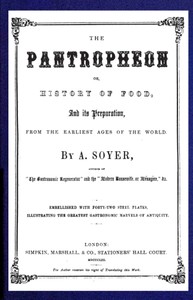
For The Pantropheon; Or, History of Food, Its Preparation, from the Earliest Ages of the World — Background and Themes, the stored edition analysis reports 180,909 words, 13 hr 7 min estimated reading time, and 45 detected text sections.
The text analysis averages about 24.9 words per sentence, while the detected sections provide another way to judge how the source is divided.
Project Gutenberg metadata also associates the work with “Food,” connecting these edition facts with the source record’s subject description.
Explore this collection
These alternatives are selected using recorded categories and estimated reading time.
About 565 minutes
Home Economics
129,906 recorded words. 222 minutes difference from this book's estimate.
View Gutenberg source #63883About 531 minutes
Home Economics
122,081 recorded words. 256 minutes difference from this book's estimate.
View Gutenberg source #6745About 509 minutes
Home Economics
117,060 recorded words. 278 minutes difference from this book's estimate.
View Gutenberg source #56540Search stored excerpts and compare books → Choose by your preferences →
Choices use stored catalog measurements. Estimates vary with reading speed. A shared category is a catalog label, not a claim that two books have the same argument or literary quality.
Search reads excerpt text stored with this catalog and links to its associated Gutenberg record. The connection is stored in the site database; this tool does not recheck that every excerpt is word-for-word identical to that external record. Excerpt search does not cover every chapter and does not verify historical publication dates.
Catalog snapshot checked: 2026-09-26. Coverage: 91 public books, 91 available source excerpts.
Calculated from edition completeness, EPUB availability, text structure and catalogue metadata. Not a user rating.
Total of 100 points, scaled to a 2.5-5.0 range. Editions with an empty description or a missing EPUB file are not scored.
Public-domain source text
The source text is kept in the dedicated reader, separate from this catalogue record and its commentary.
Alexis Soyer's The Pantropheon (1853) organizes its encyclopedic survey of food history by moving systematically from agricultural staples—cereals, vegetables, fruits—through animal foods, poultry, game, and fish, before culminating in a detailed account of Roman banquets and kitchen operations. The work's structure reflects a taxonomic impulse, yet within this framework Soyer repeatedly shifts between catalog-like enumeration and immersive scene-painting, particularly when describing the Roman archimagirus (chief cook) commanding his kitchen like a general on a battlefield.
Recurring images of fire, metal vessels, and hierarchical labor anchor the narrative. Soyer draws explicit parallels between ancient and modern utensils—gridirons, cullenders, dripping-pans—while noting that Roman examples were often plated with silver. This interplay of distance and familiarity gives the work its distinctive texture.
The book's table of contents reads like a botanical and zoological inventory: chapters on cereals, kitchen garden plants, stone fruits, shell fruits, then pigs, oxen, poultry, and game. This arrangement suggests a logical progression from cultivation to consumption. Yet Soyer does not simply list; he embeds historical anecdotes and etymological notes within each category. For instance, the section on beans notes their use in ancient religious rites, while the entry on the pig traces its role from sacrifice to banquet centerpiece.
The taxonomy is not rigid. Interspersed are chapters on markets, butchers, and hunting, which break the catalog rhythm with procedural detail. The effect is a work that oscillates between reference manual and narrative history, held together by the author's evident fascination with how ingredients became dishes.
One of the most vivid passages describes the Roman kitchen as a "magiric laboratory" where the archimagirus sits on a raised platform, surveying stock-pots and brick stoves. Soyer compares him to a general commanding battalions, invoking victory. The scene is populated with slaves, a cock sacrificed to the Lares, and an immense iron grate blown into flame by an "unhappy slave."
This theatricality extends to the utensils: a vast brass cauldron from Argos, a frying-pan for delicate cakes, and the authepsa—a double-bottomed saucepan that cooks "almost without fire." Soyer's language here is deliberately ornate, contrasting with the drier catalog sections. The kitchen becomes a stage where social hierarchy, technology, and sensory experience converge.
Throughout the excerpts, fire appears as both practical tool and symbolic force. The slave blowing the grate, the cock sacrificed in December, the cauldron on its tripod—these details accumulate into a pattern of controlled heat and ritual. Metal vessels are described with precision: bronze plated with silver, Corinthian brass, the authepsa's ingenious double bottom. Soyer often notes the material and origin of utensils, grounding his history in physical objects.
Hierarchy is another recurring thread. The archimagirus commands silent assistants; slaves perform the most arduous tasks; the cook may receive a crown of flowers. These social layers mirror the structure of the book itself, where the author presides over a vast array of facts, organizing them with visible authority.
Soyer frequently shifts from ancient to modern, comparing Roman chimneys to those of his own time. He cites Aristophanes and Appian to prove that chimneys existed, then adds: "These two examples will preclude the necessity of more ample citations." This confident leap from classical text to material culture typifies his method.
The work also moves between scales: from the single utensil (a cullender with small holes) to the grand banquet. Soyer's descriptions of the authepsa or the silver-plated gridiron invite the reader to imagine handling these objects. This tactile quality, combined with the author's willingness to editorialize, gives The Pantropheon a distinctive voice—learned, opinionated, and occasionally wry.
Readers approaching The Pantropheon will find a work that rewards browsing as much as sequential reading. The index and table of contents allow quick navigation to specific ingredients or practices, while the longer descriptive passages—especially those on Roman feasts—offer immersive set pieces. Soyer's voice is that of a connoisseur who delights in both the arcane and the familiar, making this a useful companion for anyone interested in the deep history of what appears on the table.
That book’s vast history of food felt like wandering through someone’s warm, cluttered kitchen across centuries. It left me thinking about how much care sits inside simple daily acts, quietly repeated. Later, I found that same gentle attention in The Healthy Life Cook Book, 2d ed. — Edition Insights, where plain nourishment carries its own quiet dignity. Reading it, I just felt a little steadier, somehow.
A brief reflection can help important ideas stay with you longer.